
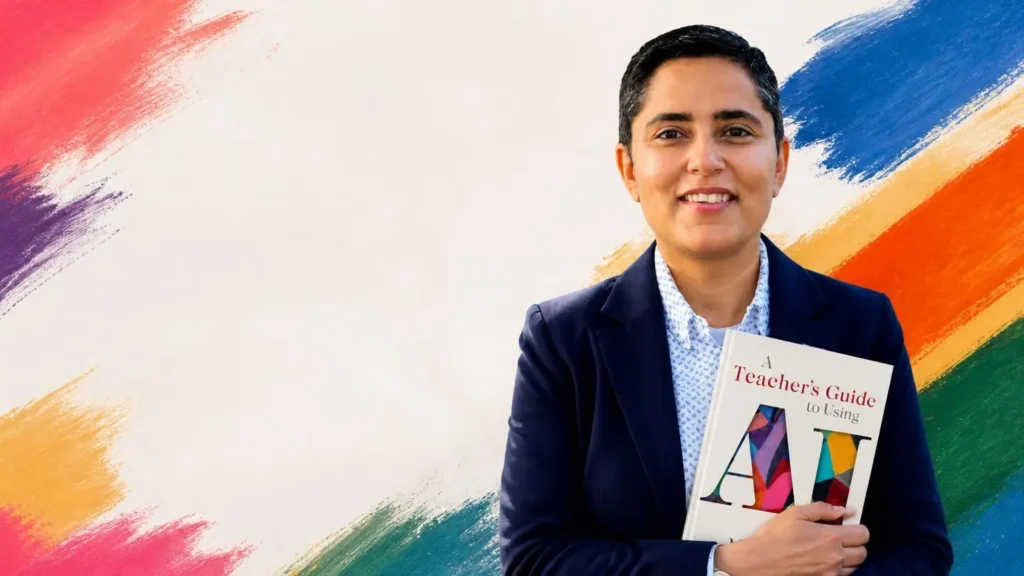
Cutting Through AI Hype and Fear: Why This Book Arrives at the Right Moment
Walk into almost any school staffroom in India today and you will hear two competing voices about artificial intelligence. One claims AI will magically solve every teaching challenge overnight; the other worries it will erode student thinking and make teachers obsolete. Most educators sit somewhere in the middle—curious, pressed for time, and looking for honest, classroom-tested guidance rather than Silicon Valley sales pitches.
That is precisely why A Teacher’s Guide to Using AI by Meenoo Rami (published by Heinemann in January 2026) stands out. Neither a breathless AI evangelist nor a doom-and-gloom sceptic, Rami offers teachers a calm, clear-eyed map and compass for deciding when, why, and how to use AI without losing their voice, their values, or their students.
Meet the Author: Why Meenoo Rami’s Dual Background Matters to Teachers
One of the biggest reasons AI books for schools fail is that they are written either by technologists who have never managed a noisy classroom or by commentators who do not understand how AI products are actually built. Meenoo Rami bridges both worlds effortlessly.
A National Board Certified Teacher and National Writing Project leader with more than a decade of classroom experience, Rami has also spent nearly a decade inside education technology—including leadership roles at Microsoft Education and Minecraft Education, and receiving the NCTE Conference on English Leadership Innovative Leadership Award. Her guiding principle runs through every chapter: technology should serve teaching and learning, never the other way around.
Keeping Humanity at the Centre of the Classroom
At the heart of A Teacher’s Guide to Using AI is a deeply reassuring thesis: AI does not replace the human soul of teaching—when used with discernment, it can protect and magnify a teacher’s compassion, creativity, and care for students.
Rami reminds educators to trust their own professional judgement rather than passively reacting to every new app. For Indian school teachers managing large class sizes, syllabus deadlines, and diverse learning levels, this human-centred framing is refreshing. It puts teacher agency first, insisting that pedagogy—not software—must always remain in the driver’s seat.
Practical Teacher-Facing Workflows That Actually Save Time
While grounded in research and reflection, this is far from a purely theoretical book. Rami packs the pages with concrete strategies, classroom examples, and ready-to-adapt prompts for everyday teacher workflows:
– Lesson Planning and Curriculum Design: Using AI as a brainstorming partner to structure unit plans, differentiate reading levels, and generate local classroom examples.
– Assignment Design and Refinement: Crafting prompts and rubrics that reward authentic student thinking rather than copy-paste outputs.
– Feedback and Data Analysis: Streamlining routine formative feedback and spotting patterns in student performance so teachers reclaim hours for one-on-one mentoring.
Teaching Students About AI Before Putting AI in Their Hands
Perhaps the smartest pedagogical choice Rami makes in the book is how she sequences student-facing AI use. Rather than rushing to hand chatbots to learners, she prioritises teaching students about AI first.
Educators receive structured guidance on helping students understand:
– What AI actually is—and what it is not.
– Its real capabilities alongside its blind spots, hallucinations, and biases.
– Ethical considerations, academic integrity, and potential risks.
– How to use AI intentionally to support their own agency and learning rather than outsourcing their thinking.
Tackling Ethics, Law, Equity, and Critical Literacy Head-On
Many quick-fix AI guides gloss over the hard questions. Rami does not. She weaves historical context, research, law, and ethics directly into her practical advice.
She invites educators to move beyond “which tool should I use?” and ask deeper questions about equity, student privacy, and voice. For school leaders in India formulating institutional AI guidelines under CBSE or state frameworks, these chapters provide a balanced foundation for policy discussions with parents, trustees, and students.
Why This Book Resonates Especially Well in Indian Classrooms
Although written with global classrooms in mind, the principles in A Teacher’s Guide to Using AI translate seamlessly to Indian schools:
– High Teacher Workload: Teacher-facing AI workflows for drafting differentiated worksheets, multilingual parent communication, and formative quizzes directly ease administrative burnout.
– Board Exam vs. Critical Thinking Tension: Rami’s emphasis on authentic project-based learning and thoughtful assignment design helps teachers push beyond rote memorisation even when students have AI tools on their phones at home.
– Low-Barrier Entry: Whether a school is a tech-rich urban campus or a resource-conscious institution just starting its AI literacy journey, the book focuses on mindset and pedagogy rather than expensive hardware.
How to Use A Teacher’s Guide to Using AI for School Book Studies and PD
Rami’s clear structure makes this book an ideal anchor for school-wide Professional Development (PD) and department book circles. Here is a simple 4-week staffroom format:
1. Week 1 – Foundations & Mindset: Discuss what AI is and is not, and map out staff anxieties honestly.
2. Week 2 – Teacher-Facing Workflows: Have each teacher test one lesson-planning or rubric-refining prompt and share what worked and what failed.
3. Week 3 – Student AI Literacy: Co-design age-appropriate classroom norms for teaching students about AI ethics and limitations.
4. Week 4 – Department Action Plan: Draft a shared, human-centred AI usage agreement for your grade level or subject.
Who Should Read This Book (and Who Might Want Something Else)
This book is a must-read if you are:
– A K–12 teacher (novice or experienced) who wants realistic, non-gimmicky ways to use AI without sacrificing classroom connection.
– A school principal, academic coordinator, or teacher educator designing AI professional learning sessions.
– A parent-educator or curriculum designer concerned about building critical AI literacy among teenagers.
On the other hand, if you are purely looking for a technical coding manual on training machine-learning models or a hype-heavy list of 500 fleeting AI apps, this is not that book—and that is precisely its strength. Tools change every quarter; Rami’s pedagogical principles will remain relevant for years.
Final Verdict: A Wise, Grounded Companion for the AI Era
A Teacher’s Guide to Using AI by Meenoo Rami earns its place on every educator’s desk because it respects teachers as thinking professionals. It gives you practical prompts to lighten your weekly load, a thoughtful blueprint to prepare students for an AI-shaped future, and the confidence to draw ethical boundaries when a tool does not serve learning. If you read only one book on classroom AI this year, make it this one.

Frequently Asked Questions
Who is the author of A Teacher’s Guide to Using AI?
The book is written by Meenoo Rami, a National Board Certified Teacher, National Writing Project leader, and AI and education strategist with over a decade of classroom teaching experience and nearly a decade in education technology.
When was A Teacher’s Guide to Using AI published and by whom?
A Teacher’s Guide to Using AI was published by Heinemann in January 2026 (ISBN: 9798202097416).
Is this book suitable for teachers who are complete beginners with AI?
Yes. Meenoo Rami writes in an accessible, jargon-free tone that helps both complete beginners and tech-savvy teachers understand what AI is, what it is not, and how to use it thoughtfully.
Does the book include practical prompts and classroom examples?
Yes. It includes numerous practical prompts, tested classroom examples, and actionable strategies covering lesson planning, assignment refinement, curriculum planning, student data analysis, and feedback.
How does Meenoo Rami approach using AI with students?
She strongly prioritises teaching students about AI—its capabilities, limitations, ethical considerations, and risks—before putting AI tools directly into their hands.
Does the book promote AI uncritically?
Not at all. Rami takes a balanced, clear-eyed stance that neither blindly celebrates AI nor succumbs to panic, consistently centring teacher judgement, ethics, and human connection.
Can school leaders use this book for teacher training or book studies?
Yes. Its blend of research, reflection prompts, and practical strategies makes it well suited for school-wide book studies, department workshops, and professional development series.
Is A Teacher’s Guide to Using AI relevant for Indian school teachers?
Yes. Because the book focuses on human-centred pedagogy, workload reduction, ethical AI literacy, and critical thinking rather than US-only software, its strategies apply directly to CBSE, ICSE, IB, and state-board classrooms in India.
Does the book address AI ethics and academic integrity?
Yes. It explores law, ethics, bias, equity, and responsible student use in depth so educators can build thoughtful classroom norms.
Where can teachers learn more about the book and Meenoo Rami’s work?
Educators can explore book details, speaking topics, and professional learning resources through Heinemann’s official website and Meenoo Rami’s website (meenoorami.com).
While Meenoo Rami’s guide offers a practical framework for bringing AI into everyday lessons, using any new technology well still depends on strong, locally grounded pedagogy. Educators looking to pair these AI strategies with foundational Indian classroom research can explore this list of books and publications by Azim Premji University for teachers in India.

 Teach Like a Pirate” Review: How to Turn Your Classroom Into a High-Energy Learning Adventure
 List of Books and Publications by Azim Premji University for Teachers in India
 Foundational Literacy and Numeracy: Why Classroom Teaching Practices Matter More Than Assessments

