
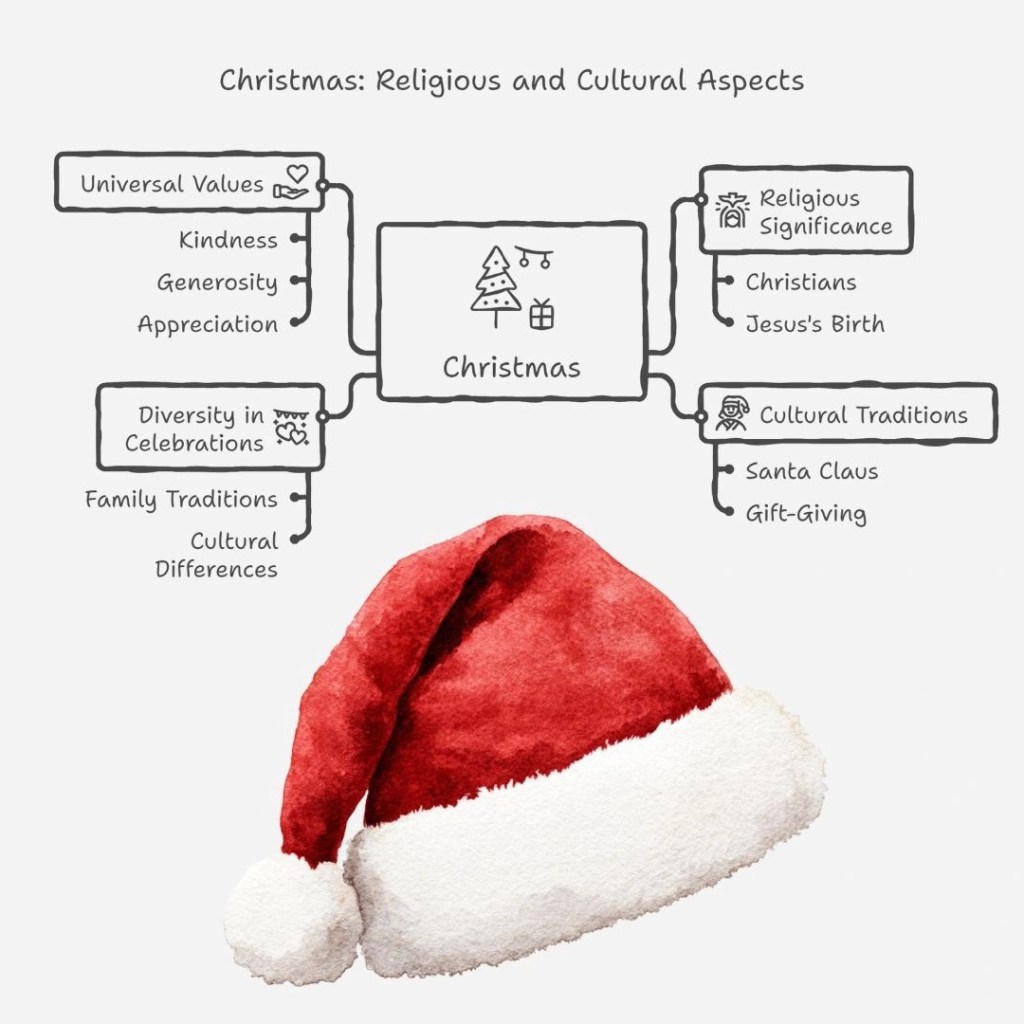
Walking into a December classroom often means navigating questions about Christmas, Santa, and traditions that carry different meanings for different families. As educators, we’re tasked with honoring cultural celebrations while respecting the diverse beliefs of our students. Here’s how to approach these conversations with sensitivity and clarity.
Table of Contents
Understanding Christmas Beyond the Surface
Christmas holds dual significance in modern society. For Christians, it marks the birth of Jesus Christ—a sacred religious observance centered on faith and spirituality. But step into most shopping centers or public spaces in December, and you’ll encounter a different version: one filled with decorated trees, gift-giving, and a jolly figure in red.
This secular Christmas has evolved into something broader than its religious roots. It’s become a cultural moment that many people participate in regardless of their faith background. Think of it like Thanksgiving—while it has historical and spiritual dimensions for some, others embrace it simply as a time for gathering and gratitude.
When students ask whether Christmas is “just about presents” or “really about Jesus,” the honest answer is: it depends on who you ask. For some families, the religious meaning is everything. For others, it’s a cherished cultural tradition with no spiritual component. Both perspectives deserve acknowledgment in our classrooms.
The Santa Conversation: Navigating Tricky Territory
Perhaps no December topic generates more uncertainty for teachers than Santa Claus. Parents have strong feelings about this fictional figure, and those feelings vary wildly from household to household.
Here’s the educational sweet spot: frame Santa as a story that teaches values, much like the fables and folk tales we use throughout the year. We don’t tell students that the tortoise literally raced the hare, yet we embrace the lesson about persistence. Santa can work the same way.
When a child asks directly if Santa is real, a thoughtful response might sound like: “Santa is a story that represents kindness and giving—values that are very real.” This approach respects family choices while keeping the focus on what matters educationally: the principles behind the narrative.
Avoid confirming or denying Santa’s existence outright. Your role isn’t to preserve or shatter childhood magic—that’s a family decision. Instead, guide students toward the meaningful ideas embedded in the tradition: generosity, thinking of others, and the joy of giving without expecting recognition.
Creating an Inclusive December Classroom
The phrase “everyone celebrates Christmas” doesn’t reflect reality in most schools today. Our classrooms contain students from Christian, Jewish, Muslim, Hindu, secular, and countless other backgrounds. Some celebrate Christmas religiously, some culturally, and some not at all.
Language matters enormously here. Shift from “What is everyone doing for Christmas?” to “Many people celebrate different things this time of year. What does your family do?” This small adjustment opens space for all students to feel seen.
When teaching about Christmas specifically, present it as one example of how cultures mark the winter season. Compare it with Hanukkah’s themes of light and resilience, Kwanzaa’s focus on community and heritage, or Diwali’s celebration of triumph. The goal isn’t to homogenize these distinct traditions but to help students recognize common human values expressed through different cultural lenses.
Let students become the experts on their own family traditions. Create opportunities for them to share—not perform—what’s meaningful in their homes. A student describing their family’s Christmas Eve rituals or explaining why they don’t celebrate at all both contribute to everyone’s cultural literacy.
The Values Hiding in Holiday Lessons
Strip away the wrapping paper and religious symbolism, and Christmas activities in schools can teach essential social-emotional concepts.
Empathy grows when students consider what gifts would make others happy rather than just what they want themselves. Gratitude develops through reflecting on what they have and who provides for them. Sharing becomes tangible when classes organize donation drives or create cards for community members.
These aren’t Christian values or secular values—they’re human values that transcend any single tradition. A kindness calendar that tracks daily good deeds works just as well in December as in March. Discussion about giving to those with less connects to units on community responsibility. Comparing festivals across cultures builds critical thinking about how different societies express similar ideals.
Frame activities around the universal rather than the particular. Instead of “making Christmas cards,” try “creating kindness cards.” Rather than “Santa’s workshop,” consider “a giving project.” These shifts preserve the seasonal spirit while remaining truly inclusive.
When Parents Object or Questions Get Complicated
You’ll likely encounter pushback at some point. Some parents may object to any Christmas content in schools, viewing it as religious indoctrination. Others may insist their child shouldn’t be exposed to information suggesting Santa isn’t real. A few might question why school time goes toward any December celebrations.
These concerns deserve respectful responses. To parents worried about religious content, clarify your cultural approach and your care in presenting Christmas as one tradition among many. To those protective of Santa belief, explain your policy of neither confirming nor denying while focusing on values. To families who see December festivities as frivolous, emphasize the learning objectives around empathy, cultural awareness, and historical understanding.
Students themselves will ask pointed questions. “Is Santa in the Bible?” (No, Santa Claus as we know him developed from various sources including Saint Nicholas, a historical figure, but he’s not a biblical character.) “Why do we have Christmas trees?” (The tradition has pagan roots and was adopted into Christian celebration in Germany, then spread globally as a secular symbol.) “Why does our school do Christmas stuff?” (We explore it as a significant cultural phenomenon, not as a religious endorsement.)
Address these questions factually and age-appropriately. Older students can handle nuanced discussions about how traditions evolve and take on new meanings. Younger children need simpler framing: “Different families believe different things, and that’s what makes our classroom interesting.”
A Framework Students Can Understand
If you want to distill this complexity into something kids can grasp, try this simple summary:
Christmas celebrates Jesus’s birth for people who are Christians—that’s the religious part. Santa is a story about being kind and generous that many people enjoy, whether they’re religious or not. Not everyone celebrates Christmas, and that’s perfectly okay. Different families have different traditions, and we can learn from all of them. What matters most isn’t which holiday you celebrate, but understanding the good values that many celebrations teach: being kind, thinking of others, and appreciating what we have.
Moving Forward with Confidence
Teaching about December traditions doesn’t require walking on eggshells, but it does require intentionality. Recognize Christmas for what it is—both a religious holy day and a cultural phenomenon. Treat Santa as a teaching tool rather than a truth claim. Use inclusive language that makes space for all your students. Focus on universal values rather than specific beliefs.
Your classroom can honor the excitement many children feel about this season while ensuring no student feels excluded or pressured. That balance isn’t just possible—it’s essential. When done thoughtfully, exploring Christmas and winter traditions becomes an opportunity to practice the very values we hope to instill: respect, empathy, and appreciation for the rich diversity of human experience.
The goal isn’t to remove meaning from Christmas for those who cherish it, nor to impose it on those who don’t. It’s to create a space where every student feels valued, where curiosity is welcomed, and where December becomes a chance to understand both our differences and our shared humanity.