
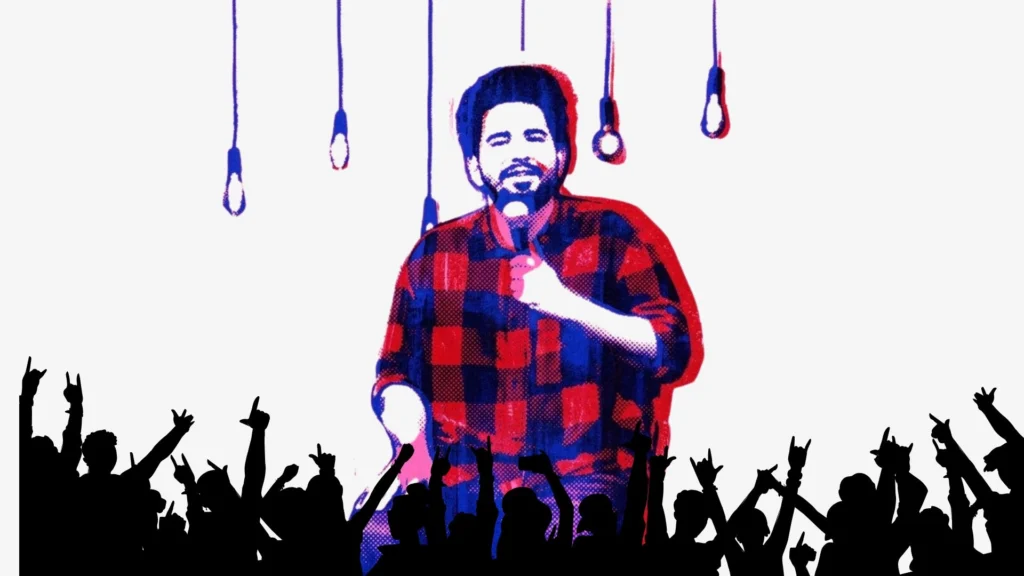
SAMAY RAINA · 2025
Educated Times · Pedagogy & Culture · April 2026
Why High School Teachers Cannot Afford to Disown the Comeback of Samay Raina
Section 01 — The HookThe Classroom Reality Nobody Talks About
Here is a scene playing out in every high school corridor in India right now. Two students huddle over a phone during the lunch break. One whispers “Did you watch the special?” The other nods and replies with a single word — “Genius.” They are not talking about a textbook. They are talking about Samay Raina’s sold-out comeback special, Still Alive.
Meanwhile, forty feet away, their teacher is preparing a lesson on resilience and growth mindset — possibly from a PowerPoint that was last updated in 2019.
This is the fundamental tension sitting at the heart of contemporary Indian education: the classroom is ordered, but the world students actually inhabit is chaotic, layered, and algorithmically alive. And in 2025–26, one of the loudest voices in that digital world belongs to a chess-playing stand-up comedian from Kashmir who turned a national controversy, two FIRs, and a public cancellation attempt into one of the most-talked-about comeback narratives in Indian entertainment history.
The question is not whether you like Samay Raina. The question is whether you can afford to ignore what his phenomenon is teaching your students — often more vividly than you can.
“The classroom is where you teach resilience. The internet is where students watch it performed live. One of these has their full attention.”
Failing Up: A Masterclass Your Textbook Couldn’t Write
Teachers spend years teaching Carol Dweck’s Growth Mindset — the idea that failure is not a verdict, it is data. It is an admirable framework. It is also, for most 16-year-olds, an abstraction until they see it lived in real time.
In early 2025, Samay Raina faced what the media unanimously called a “downfall.” The India’s Got Latent controversy detonated across social media. FIRs were filed. Brands distanced themselves. Commentary channels posted funeral thumbnails. The narrative machine had decided: he was finished.
He was not finished.
Still Alive was not just a title — it was a thesis statement. The special sold out. The audience that showed up was not there out of sympathy; they were there because authenticity in crisis is magnetic. Samay did not pivot to apologies or rebrand himself into palatability. He walked on stage and named exactly what had happened to him, then kept going.
Consider what your students are actually processing when they call this “genius.” They are recognising, intuitively, a principle that every educator tries to teach explicitly: the person who controls the narrative of their own failure is the person who survives it.
Against Him
Post-Controversy
Called It “Genius”
Compare this to the typical classroom case study on resilience: a historical figure, safely distant, conveniently resolved. Samay’s story is unresolved, messy, ongoing — and that is precisely why it lands. Resilience is not a biography; it is a live event.
“Resilience is the only curriculum that matters in 2026. Everything else is a prerequisite.”
“Character” vs. “Persona”: What Gen Z Actually Rewards
Central to Samay’s comeback narrative was his very public falling-out with Ranveer Allahbadia — a figure who represents, almost architecturally, the opposite aesthetic: curated wisdom, polished delivery, manufactured spirituality wrapped in hustle-culture packaging.
The contrast is instructive for educators, not because one is “right” and the other is “wrong,” but because of what happened when audiences were forced to choose. Gen Z, almost categorically, sided with the chaos over the curation. They chose the person who showed the cracks over the person who claimed to have none.
This has direct implications for the classroom. The authority figure who performs perfection — the teacher who never says “I don’t know,” who never admits a bad day, who maintains a frictionless professional surface — is the authority figure Gen Z trusts least. Not because they are wrong to project authority, but because students who live in a world where authenticity is the primary currency of online trust are fluent detectors of performance.
Samay Raina grew up Kashmiri — a biography that carries a specific weight of navigating between worlds, ideologies, and narratives not of his own making. Many teachers feel a version of this daily: caught between administrative policy and student reality, between institutional expectation and genuine human connection. The educator who acknowledges this crossfire — rather than pretending it doesn’t exist — is the educator who builds actual trust. Samay didn’t pretend the crossfire away. He made it the material.
The lesson is not to be unprofessional. The lesson is to be genuinely present. Students do not need a perfect adult in the room. They have algorithms for curated perfection. They need a real one.
“Gen Z does not distrust authority. They distrust the performance of authority. Know the difference — it is the entire difference.”
Meta-Humour as the New Literacy
Why do students call Samay’s comedy “layered”? Why do they use the word “genius” for jokes that, on the surface, seem absurdist or even deliberately low-effort?
Because the surface is not the joke. The joke is a comment on the joke. The meta-layer is the actual payload.
This is a specific kind of communication intelligence — and it is not accidental. Students who consume this content daily are developing fluency in irony, in reference-stacking, in the performance of self-awareness. They are learning to read at multiple registers simultaneously. That is not a trivial cognitive skill. Rhetoricians have a name for it: it is called epideictic discourse — communication that comments on itself while communicating.
When a teacher doesn’t understand the layers, one of two things happens in the classroom. Either the student feels unseen — their actual intellectual world invisible to the adult meant to guide them — or the teacher attempts to engage and misreads the register entirely, producing the worst outcome: an adult trying to be “cool” and failing publicly.
- You do not need to love the content. You need to understand the structure of why it works. Ask your students to explain the layers — not as a gotcha, but as genuine inquiry.
- Use it as a text. A Samay bit that subverts expectation is a live lesson in narrative misdirection, comedic timing, and audience contract. These are literary concepts wearing hoodies.
- Acknowledge the vocabulary gap. Students respect educators who say “I don’t speak this language natively, but I want to learn it.” That is not weakness. That is the growth mindset you’ve been preaching made visible.
- Map the layers to your subject. History is full of meta-narratives. Science is built on the idea that what we think we know is always provisional. Literature is nothing but layers. The intellectual structure is transferable.
“If you can’t read the layers, you can’t bridge the gap. Meta-humour is not a distraction from literacy — in 2026, it is a form of it.”
It Is Not a Competition. It Is a Lesson in How to Hold the Room.
Samay Raina commands attention at a scale that dwarfs most educational content channels in India — not because education is boring by definition, but because the mechanics of attention operating in entertainment are ones that educators have historically underinvested in understanding.
Consider what Samay does structurally in his content: he establishes a premise, immediately subverts it, rewards the audience for paying close attention, and creates a feedback loop where engagement feels like participation. Every classroom teacher reading this should recognise that structure — it is, in fact, the structure of excellent pedagogy.
The problem is not that students won’t pay attention. The problem is that their baseline for what “holding attention” looks like has been recalibrated by years of content that performs at the highest possible level of engagement mechanics. Walking into a classroom in 2026 without thinking about those mechanics is like walking in without lesson plans — technically possible, pedagogically indefensible.
This is not a call to compete with Samay Raina for entertainment value. It is a call to learn from how he holds a room — the strategic use of vulnerability, the precision of timing, the reward structure he builds for an engaged audience — and to ask honestly which of those tools can be adapted, without compromising dignity or professionalism, into the classroom.
Section 06 — The Bridge
Stop Policing the Culture. Start Processing It.
The instinct to disown Samay Raina — to dismiss the phenomenon as “inappropriate,” to ban the discussions, to treat the enthusiasm as a behavioural problem rather than a cultural signal — is understandable. Some of the content is genuinely not classroom-appropriate. Nobody is asking you to screen India’s Got Latent at the morning assembly.
But disowning the phenomenon — the resilience story, the authenticity argument, the communication intelligence it is building in your students — is an act of pedagogical self-harm. It does not protect students from the culture. It simply removes the educator from the conversation, handing the interpretation of that culture entirely to the algorithm.
Disowning it makes you obsolete. Analysing it makes you an ally.
The 45-year-old teacher who sits down with their 16-year-old student and says — “Explain to me why this is genius. I’m genuinely asking” — is not losing authority. They are performing the most authoritative act available to an educator: the modelling of genuine intellectual curiosity in the face of unfamiliar territory.
That is, incidentally, exactly what Samay Raina did when the ground fell out from under him. He sat with the chaos, made sense of it on his own terms, and came back with a show called Still Alive.
Resilience. Authenticity. Narrative control. The ability to hold a room when the room doesn’t want to be held.
You have been teaching these things for years.
Your students just watched someone else perform them better. The only question worth asking now is: what are you going to do about that?
“The educator who understands what their student calls ‘genius’ is the educator who still has a chance to shape what genius looks like next.”
The classroom that ignores the culture
doesn’t protect students from it.
Share this piece with every educator who’s ever said “I don’t understand what they watch anymore.” That feeling is the starting point — not the excuse.

