Typing Like an Old Man to AI Agents Might Be the Best AI Hack You Can Master in 2026
Slow down. Think it through. Say exactly what you mean. The educators winning with AI are the ones who treat every prompt like it matters — because it does.
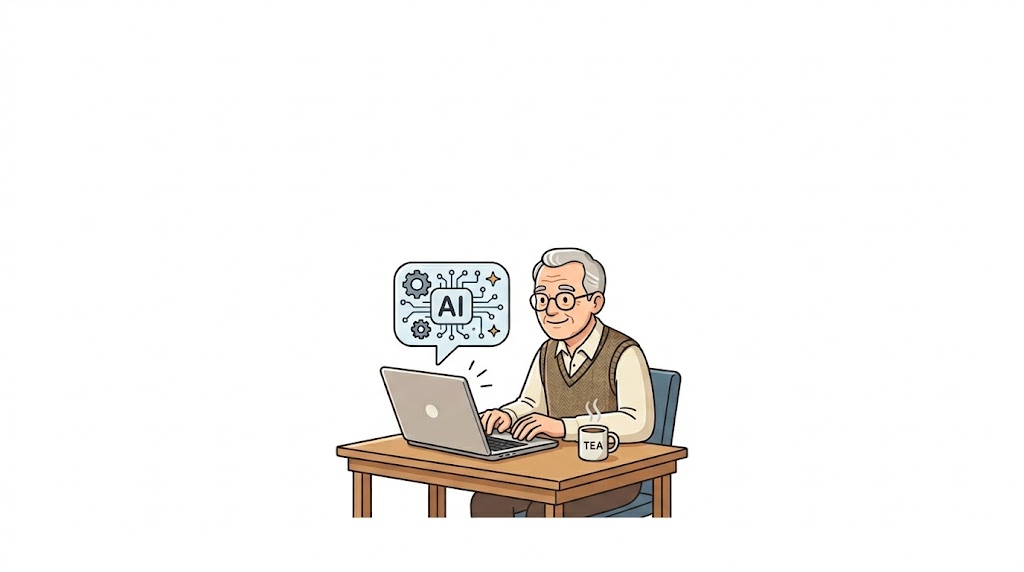
Picture someone older at a keyboard. They don’t rush. They think before their fingers move. They re-read what they’ve typed. They ask themselves: Is this actually what I mean? Then — and only then — they press send.
Now picture the average person interacting with an AI tool today. A few tapped words. A vague half-thought. Something like “give me a lesson plan” or “summarize this for students.” Then, when the output lands flat, they conclude: the AI isn’t that great.
The AI wasn’t the problem. The prompt was.
This is the single most important insight every educator needs to internalize before going another step deeper into AI-powered teaching: the quality of your output is almost entirely a function of the quality of your input. In the age of AI agents, deliberate and thoughtful prompting isn’t slow — it is the actual skill.
“Slow is smooth. Smooth is fast.” The old military maxim applies perfectly to working with AI. A thoughtful 60-second prompt beats a rushed five-word one every single time.
Why Speed Is the Enemy
We’ve been conditioned by search engines. Type a few words, scan the results, move on. It works for finding things. It catastrophically fails for creating things.
AI language models are generative — they build responses from the context you give them. Vague context produces vague output. Specific, structured, thoughtful context produces specific, structured, thoughtful output. It is almost embarrassingly direct as a cause-and-effect relationship.
The educators and professionals getting remarkable results from AI tools in 2026 share one trait: they think before they type. They draft their prompts the way a good teacher drafts a question for a classroom discussion — with purpose, with precision, and with a clear picture of what a great answer looks like.
Before you type your prompt, ask yourself three questions: Who is this output for? What should it accomplish? What would make me say “that’s exactly right”? Write down the answers — then build them into the prompt itself.
The Prompt Is the Lesson Plan
Educators understand this intuitively in their own domain. You would never walk into a classroom and say to your students: “Discuss history.” You’d say: “Let’s examine why industrialisation, despite its economic gains, deepened social inequality for urban working families — and what that tension might teach us about technological change today.”
One of those questions produces a rich, focused, generative conversation. The other produces silence, confusion, or a five-minute tangent about something completely unrelated.
Your AI prompt is exactly the same. It is the question you are asking a very capable but entirely direction-dependent collaborator. The AI will go wherever you point it. The more clearly and thoughtfully you point, the better the destination.
Weak Prompts vs. Strong Ones — Real Examples
Let’s make this concrete. Here are examples of weak prompts versus strong ones, in contexts that matter directly to educators:
The difference isn’t effort — it’s thought. The stronger prompts took perhaps 45 extra seconds to write. The outputs they generate are dramatically more useful, often requiring little to no editing.
The AI doesn’t know what “good” looks like for your classroom. You do. Your job as the prompter is to transfer that knowledge into the prompt itself.
The CRAFT Framework for Educator Prompts
If you want a simple mental model to apply every time you sit down to prompt an AI tool, use CRAFT. Five questions. One minute. Dramatically better results.
Who are your students? What grade, age, subject, and prior knowledge?
What role should the AI play? Explainer, quiz-maker, editor, or devil’s advocate?
What is the specific, measurable output you actually need?
How should it be structured? Length, tone, reading level?
Before submitting — would a great teacher understand exactly what you need?
This Is the AI Literacy Lesson Your Students Need Too
Here’s the deeper pedagogical point: when you model thoughtful prompting in front of your students, you are teaching them something far more important than how to use a software tool. You are teaching them critical thinking made visible.
Prompting well requires students to clarify what they actually want — which is often harder than it sounds. Vague desire produces vague prompts. Forcing specificity forces self-understanding. It requires them to anticipate their audience: who will read this? What do they already know? Prompting for context is empathy in practice.
It also requires them to evaluate the output honestly — does this actually answer what I asked? Is this good? Could it be better? These are the same critical reading skills we have always taught. And when the first output isn’t right, students must learn to refine the prompt rather than blame the tool. That is genuine problem-solving behavior.
Give students the same weak prompt and the same strong prompt side-by-side. Ask them to compare the AI outputs. Then have them write why the outputs differ. In one exercise, you’ve covered AI literacy, writing clarity, and analytical reading simultaneously.
But Won’t AI Just Get Smarter and Fix This?
This is the most common pushback — and it misses the point. Yes, AI models are improving at inferring intent from sparse input. But even if AI becomes twice as good at reading between the lines, a thoughtful and specific prompt will always outperform a vague one. The gap may narrow — the principle never disappears.
A surgeon with the best instruments in the world still needs to know anatomy. A pilot with the most advanced cockpit still needs to know where they are flying. The tool amplifies the operator. It does not replace the need for the operator to know what they are doing.
The educators, students, and professionals who build the habit of deliberate prompting now — while others are still mashing keys and hoping — will be operating at a fundamentally different level regardless of how AI evolves.
The Old Approach Had It Right
There is something almost countercultural about this advice in 2026, when every product is optimised for speed and frictionlessness. Slow down. Think. Be deliberate. Write it out properly before you send.
Typing carefully — hunting and pecking, re-reading each line — reflects an understanding that language is how thought becomes reality, and getting the language right is worth the extra moment.
With AI agents now capable of drafting reports, building lesson plans, creating assessment materials, answering student questions, and generating differentiated content at scale — the stakes of that moment before you press send have never been higher.
Think before you type. Be specific. Give context. Define the outcome. Then let the AI do what it does brilliantly: take a clear, well-formed human intention and execute it with extraordinary speed and range.
That is not a workaround. That is the skill. And mastering it in 2026 is as important as any other professional competency you will develop this year.
AI is a tool. Its output will always reflect the clarity — or the fog — of the mind behind the prompt. Master the prompt, and you master the tool.