
It was a winter afternoon in Delhi when a school principal I know walked into a classroom during a free period. The teacher had stepped out for a moment. Thirty-five students sat in silence, heads bent over their notebooks. No one was talking. No one was exploring anything. No one even looked bored.
They were simply waiting. Waiting for the teacher. Waiting for the bell. Waiting for the next instruction. The principal later told me something that stayed with me: “Nothing was wrong in that classroom. And yet everything felt wrong.” The students were disciplined. The notebooks were complete.
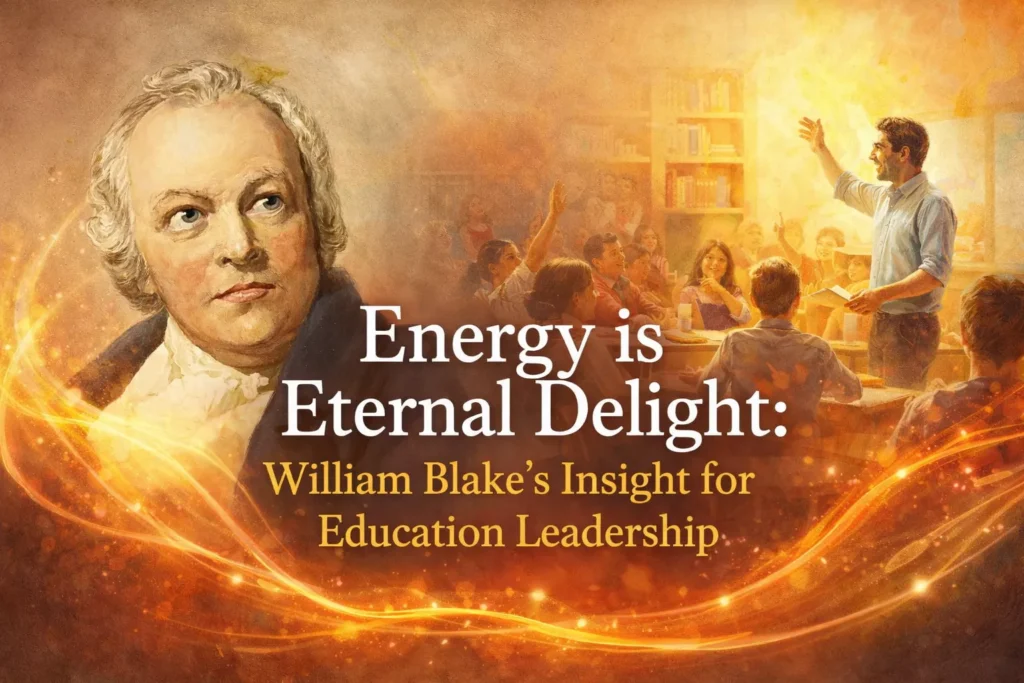
The syllabus was on schedule. But the room had no energy. That moment reminded me of a line written more than two centuries ago by the English poet and artist William Blake: “Energy is Eternal Delight.” The line appears in his philosophical work The Marriage of Heaven and Hell, written between 1790 and 1793. Blake was not writing about schools or universities, yet his insight might be one of the most important ideas educational leaders need to revisit today. Because if we look honestly at many modern classrooms, the problem is rarely intelligence or resources. The problem is energy.
To understand Blake’s line, we must first understand what he meant by energy. Blake was writing during the late Enlightenment period, a time when society increasingly celebrated reason, order, and rational systems. Intellectual life was becoming structured and disciplined. Blake admired reason, but he believed society had begun to worship it at the expense of something equally important. Energy.
In The Marriage of Heaven and Hell, Blake argues that human progress does not come from restraint alone. It comes from the tension between reason and energy. Energy, for Blake, was not chaos. It was creative force. It was curiosity. It was imagination. It was intellectual hunger. It was the restless desire to explore what has not yet been understood. Without energy, Blake believed, reason becomes sterile. Systems become rigid. Institutions become lifeless. If we look closely, this is exactly the danger many education systems face today.
Modern education systems are incredibly sophisticated. Curricula are mapped carefully across grades. Assessments are standardized. Administrative processes are documented in detail. In many ways, education has become more efficient than ever before. Yet there is a quiet paradox hiding inside this efficiency. The more structured our systems become, the easier it becomes for classrooms to lose the very force that drives learning: energy. Consider the typical classroom experience of many students. They move from subject to subject in fixed intervals. They take notes. They prepare for tests. They memorize frameworks and definitions. All the visible markers of education are present, yet the invisible spark—the moment when a student leans forward and asks a question no one expected—is becoming rarer. It is not because students lack curiosity.
Children begin life as natural explorers. Anyone who has watched a five-year-old ask questions knows that curiosity does not need to be taught. The challenge is that institutional systems sometimes discipline curiosity out of existence.
History offers fascinating reminders of how learning actually unfolds. In 1665, a plague outbreak forced the University of Cambridge to close temporarily. Students were sent home. Among them was a young scholar named Isaac Newton. Newton returned to his family farm in Woolsthorpe. For nearly two years he lived away from the university environment. There were no formal lectures, no examinations, and no institutional routines. Yet during that period Newton developed the early ideas that would later shape calculus, optics, and the theory of gravity.
Historians often refer to this period as Newton’s “Annus Mirabilis,” his year of miracles. What had changed? Newton suddenly had something many academic environments rarely provide in abundance—intellectual energy. He had time to question, experiment, and follow curiosity wherever it led. This does not mean institutions are unnecessary, but it reminds us of an important truth: breakthrough learning often happens when curiosity is allowed to breathe.
Educational leaders often focus on infrastructure, policies, and processes. These things matter. But there is another variable that quietly shapes institutions—atmosphere. Walk into two different schools and you will immediately feel the difference. In one, teachers move through routines with quiet fatigue. Conversations revolve around deadlines, reporting formats, and administrative instructions. In another, you hear animated debates in classrooms. Teachers argue passionately about ideas in the staff room. Students build projects that were never assigned. The difference is not always funding or facilities. The difference is energy. And energy, more often than not, begins with leadership. When leaders are curious, teachers feel permission to be curious. When leaders experiment, teachers feel safe experimenting. When leaders radiate enthusiasm about learning, the institution gradually reflects it. Energy cascades downward.
Another fascinating example comes from Renaissance Florence. Young apprentices entered workshops where masters like Leonardo da Vinci worked. These workshops were not classrooms in the modern sense. There were no standardized syllabi and no multiple-choice examinations. Instead apprentices observed, experimented, argued, sketched, failed, and tried again. Art blended with engineering. Anatomy blended with painting. Geometry blended with architecture. Learning was messy, but it was alive. The workshop environment generated an atmosphere where curiosity fed creativity, creativity fed experimentation, and experimentation fed discovery. This was not chaos. It was organized energy.
Educational leadership is frequently framed as an administrative function—managing the timetable, ensuring syllabus completion, monitoring assessments, coordinating departments. All of these tasks are necessary. Yet leadership has a deeper responsibility: protecting the conditions that allow intellectual energy to flourish.
Energy cannot be forced. Students cannot be ordered to feel curious. But institutions can create environments where curiosity is welcomed rather than suppressed. Sometimes this means allowing teachers the freedom to deviate from a rigid lesson plan when a discussion becomes genuinely interesting. Sometimes it means giving students space to build something that is not part of the formal curriculum. Sometimes it means accepting that meaningful learning is occasionally unpredictable.
Blake’s line, “Energy is Eternal Delight,” is easy to misinterpret as a celebration of excitement alone. But Blake’s deeper insight was about joy—not entertainment, not stimulation, but joy. The joy that appears when the mind encounters something new and struggles to understand it. Anyone who has watched a student suddenly grasp a difficult concept knows this moment. There is a brief pause, then the face lights up. That moment is energy, and it is also delight.
Education systems today face enormous pressures. Examinations determine opportunities. Institutions must maintain standards. Administrators must ensure accountability. These pressures are real. Yet amid all this structure, educational leaders must occasionally ask a simple question: are our classrooms alive? If students are only waiting for instructions, something essential has been lost. If teachers feel unable to explore ideas beyond the syllabus, something essential has been constrained. Blake’s insight reminds us that education is not merely the transmission of information.
It is the awakening of energy. When curiosity is protected, experimentation is encouraged, and leadership models intellectual enthusiasm, classrooms begin to transform. Learning becomes more than a process. It becomes what Blake believed it could be—a form of eternal delight.

