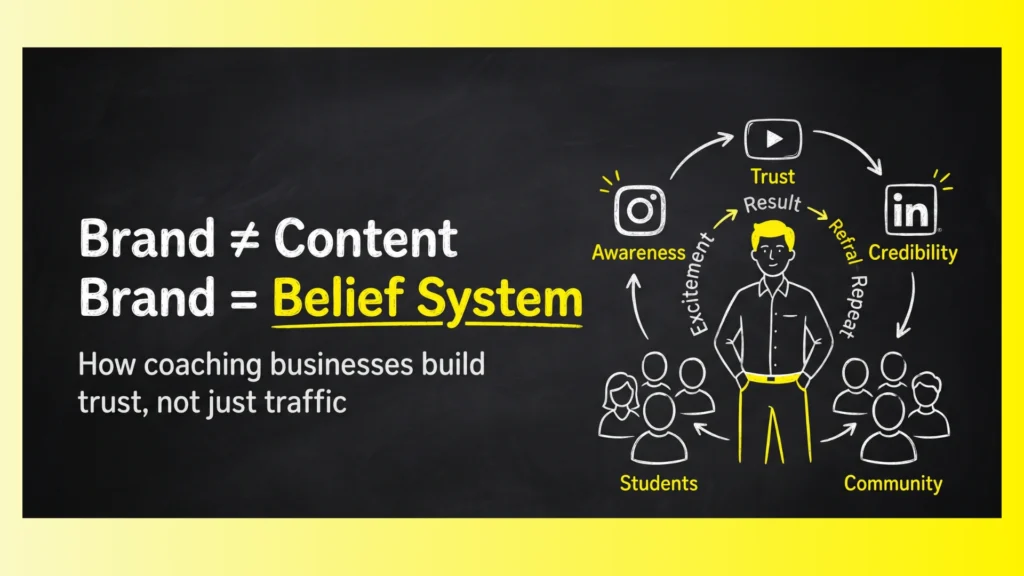
Your competitors are posting every day. They have reels, carousels, and a YouTube channel. But you still get more referrals. Why? Because you have a brand—and they just have content.
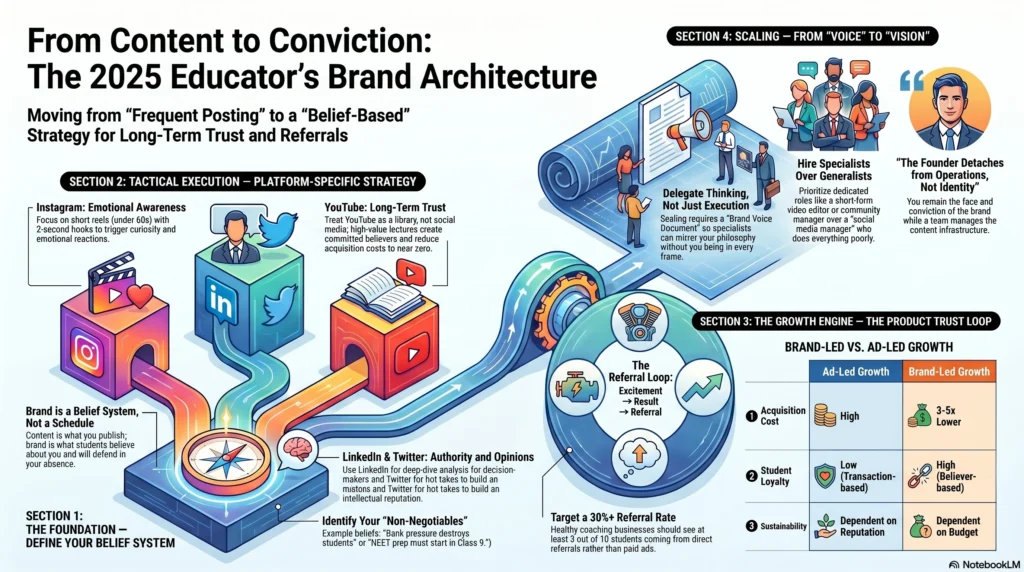
AI-assisted infographic (NotebookLM) created to visually interpret insights from the Think School Hindi podcast
Introduction: Why “Just Posting” Is No Longer Enough
India’s education market is brutally crowded right now. Whether you run a UPSC coaching center in Mukherjee Nagar, a CUET prep institute in Jaipur, or a hybrid CBSE tuition brand from your living room—you are competing with thousands of educators who all look the same online.
Same Instagram reels. Same “result posts.” Same “batch starting soon” stories.
The educators and institutes who are breaking through this noise are not the ones with more followers. They are the ones who have built something far more durable: a belief system that their audience shares.
This guide draws on a sharp, candid episode from Think School Hindi’s podcast featuring Viraj Sheth (Co-founder and CEO, Monk Entertainment), Ayush Wadhwa (Founder, Owled Media), and Aryan Anurag (Co-Founder, Binge Labs)—three of India’s most plugged-in voices in the creator economy. Their conversation on how creators and brands build sustainable income, find their niche, and outlast the algorithm is directly applicable to every coaching business owner deciding their strategy for the next 12 months.
This is not a content calendar guide. This is a brand architecture guide for education businesses. Let’s get into it.
Table of Contents
Part 1: Your Brand Is Not What You Post—It’s What You Stand For
The Insight
Most coaching institutes confuse content with brand. Content is what you publish. Brand is what people believe about you when you are not in the room. These are not the same thing.
Think of the institutes that have become household names in their city or category—the UPSC teacher whose students will defend him in comment sections they were never tagged in, the online math educator whose “ex-students” actively recruit new batches for free. That is brand. It is a belief system, not a posting schedule.
In the Think School Hindi conversation, Viraj Sheth makes a point that cuts to the core of this: niche creators—people who go deep on one subject with a clear point of view—consistently outperform broader, more generic creators in terms of engagement, loyalty, and monetization. Follower count is a vanity metric. The depth of belief your audience holds is the real asset.
Why It Matters for Coaching Businesses
The education category has one unique advantage over most consumer categories: students make high-stakes decisions. A parent choosing between two JEE coaching institutes is not making an impulse purchase. They are making a ₹1–2 lakh decision that they will think about for weeks. In that kind of decision environment, trust is the currency—and trust is built by belief systems, not by frequent posting.
How to Apply This
Start by writing down three things your institute actually believes—not what sounds good in a brochure. For example:
- “We believe NEET preparation should start in Class 9, not Class 11.”
- “We believe rank pressure destroys more students than it motivates.”
- “We believe a student who understands concepts will always beat a student who memorized patterns.”
These are opinions. They will alienate some parents and attract others—and that is exactly the point. A brand that tries to appeal to everyone appeals to no one. Put these beliefs in your communication consistently, and you will start attracting students who share them. Those students stay longer, refer more, and complain less.
The founder’s personal story is a non-negotiable part of this. Did you fail your own entrance exam before cracking it? Did you leave a corporate career because you were frustrated watching students fail for the wrong reasons? That story is your differentiation. No other institute can copy your story—but they can copy your content format, your study materials, and your pricing.
Part 2: Platform Strategy—Platforms Are Not Interchangeable, Treat Each One Differently
The Insight
One of the most practical frameworks from the Think School Hindi episode is the distinct role each social platform plays in a brand ecosystem. Ayush Wadhwa, who has built content operations for some of India’s most respected founders and creators, is emphatic on this: going wide with the same content across every platform is not “distribution strategy.” It is noise distribution. Different platforms attract different mindsets, and your content must match those mindsets.
Here is how to think about each platform through an education business lens:
Instagram → Awareness and Emotional Excitement
Instagram is where people discover you. Your goal here is not to explain your teaching methodology—it is to create an emotional reaction. Reels that show a student’s transformation, a teacher’s conviction in a tense moment, or a counterintuitive take on the exam (“Why solving more mock tests after a point actually hurts UPSC aspirants”) perform because they trigger emotion and curiosity.
Instagram’s algorithm rewards emotion and shareability, not depth. Keep posts under 60 seconds, lead with the hook in the first 2 seconds, and end with a clear call to action that moves people to your next layer—a YouTube video, a free class, a community.
What not to do: Do not post result announcements as your primary content strategy. Everyone does it, it becomes noise, and it only reaches people who already follow you.
LinkedIn → Niche Authority and Trust with Decision Makers
If you run a B2B edtech, a coaching franchise model, or a corporate upskilling program, LinkedIn is where your brand gets legitimized. But even for B2C coaching institutes, LinkedIn matters—because parents, school counselors, and district education officers are there.
On LinkedIn, your content should demonstrate thinking, not just activity. A post analyzing why CUET scores have become more predictive than board percentages, a breakdown of what separates toppers from near-toppers in UPSC Mains—these perform because they signal expertise, not just enthusiasm.
Cadence: 3–4 posts per week is sufficient. Quality of argument matters more than volume.
Twitter/X → Opinions and Network Building
Twitter/X is where you build your intellectual reputation among other educators, edtech investors, and policy influencers. Hot takes, unpopular opinions, and real-time commentary on education news perform here.
This is the platform where you can say: “The CBSE board exam is now irrelevant for college admissions, and coaching institutes that haven’t adapted will be dead in five years.” That kind of strong, defensible opinion gets retweeted, argued with, and remembered.
If you are a solo educator trying to build collaborations with other creators or get noticed by edtech platforms, Twitter/X is where that networking happens fastest.
YouTube → Long-Term Trust and the Deepest Loyalty
YouTube is where your brand gets compounded. A student who has watched 40 hours of your free content before paying for a course is not just a customer—they are a committed believer. The CAC (customer acquisition cost) for this student is nearly zero because the sale happened through education, not advertising.
This is the platform where you invest for the next 3–5 years, not the next 3–5 weeks. A well-made lecture on “How to approach RC passages in CAT” or “The one mistake that kills UPSC Prelims preparation” will continue bringing in students two years after you posted it. No Meta ad can do that.
The key principle: Treat YouTube as your content library, not your social media channel. Post less frequently, but make each video genuinely valuable enough that a student would pay for it.
Part 3: Community and the Consistency of Character
The Insight
There is a difference between consistent posting and consistency of character. Posting three reels a week is a mechanical habit. Showing up with the same energy, the same conviction, the same language every time—that is character consistency, and it is far harder to fake and far more powerful when real.
The best coaching brands in India have developed what you could call shared language—catchphrases, frameworks, and identity signals that students use even outside the brand’s content. Think of the educator whose students say “don’t just read, think” or the institute whose batch culture becomes so distinct that students identify themselves by it years after clearing their exam. That shared language is community infrastructure.
It is the same principle that Viraj Sheth and Ayush Wadhwa discuss in the context of the creator economy: creators who build communities with a distinct cultural identity—inside jokes, shared references, a unique vocabulary—retain audiences far longer than creators who simply produce high-quality content. Content can be copied; culture cannot.
Why It Matters
For coaching institutes, community is your most powerful retention and referral engine. A student who feels they belong to something—not just attend a class—will:
- Stay enrolled through difficult phases
- Actively recruit peers and siblings
- Defend your reputation online when negative reviews appear
- Come back for the next course or exam cycle
How to Apply This
Create shared context deliberately. This could be:
- A specific framework you teach and brand: “The 3-Layer Answer Method for UPSC GS2”
- A motto that students internalize: “Slow is smooth, smooth is fast”
- A batch identity: “IIT Samurai 2026 Batch” that becomes a student-led identity
Consistency of character also means your communication tone does not shift based on whether you have 500 followers or 50,000. The educator who shows the same seriousness, the same warmth, and the same teaching style in a 200-view video as in a 200,000-view video is the one who gets recognized as genuine.
What to stop doing: Changing your brand aesthetics, communication tone, or messaging every six months because you are chasing trends. Students and parents notice this instability—it makes you look like you don’t know who you are. Brands with deep conviction look the same whether it’s January or July.
Part 4: The Product Growth Loop—How Brand Trust Directly Reduces Your Cost to Acquire Each Student
The Insight
The most expensive way to grow a coaching business is paid advertising. The cheapest way is referral—a student or parent recommending you because they trust you completely. Between those two extremes is a loop that the best education brands run deliberately:
Excitement → Result → Referral → Repeat
A prospective student encounters your brand (YouTube, Instagram, word of mouth) and gets excited—not just informed. They enroll, they get a real result (a rank, a score improvement, a concept finally clicked). That result becomes a story they share—referral. And that referred student enters the same loop.
This loop directly compresses your Customer Acquisition Cost (CAC). If you spend ₹500 in advertising to acquire a student who then brings in two more, your effective CAC is ₹167, not ₹500. At scale, institutes with strong brand-driven referral loops have acquisition costs that are 3–5x lower than those relying on Meta and Google ads.
The Role of Brand-Led Trust
The key word in the loop is excitement. Students don’t refer because the course was adequate—they refer because they felt something. That emotional response is a direct output of brand. An educator who teaches clearly but communicates blandly will produce satisfied students. An educator who teaches clearly and has a compelling brand will produce evangelists.
This is what separates a ₹30 lakh per year coaching business from a ₹3 crore per year one. The teaching quality may be similar. The brand is not.
How to Apply This
Map your current referral rate. For every 10 students, how many came through referral? If it’s less than 3, your brand-to-product trust loop is broken somewhere. The fixes are usually:
- Excitement gap: Your social presence is not generating emotional investment before enrollment
- Result gap: Your pedagogy is not producing visible, shareable results
- Referral activation gap: You never ask happy students to refer, or you make it awkward to do so
Fix the excitement gap with the platform strategy above. Fix the result gap with actual pedagogy review—this guide cannot do that for you, but be honest about it. Fix the referral gap by building a structured referral moment: a WhatsApp message to the top 10% of students after each result cycle, a referral discount that feels generous, a public acknowledgment of referrers in your community.
Part 5: Scaling the Brand—The Founder Must Become the Vision, Not the Voice
The Insight
Most coaching brands stall at a certain scale because the founder is the brand. The educator who teaches all classes, answers all DMs, makes all content, and does all sales calls. This works until it doesn’t—and when it breaks, it breaks hard.
The critical shift for scaling is this: you must delegate thinking, not just execution. Hiring someone to edit your reels while you still script and film everything is not delegation—it is labor outsourcing. Real brand scaling happens when someone else can produce content that captures your worldview without you being in the room.
This requires writing down your belief system (as discussed in Part 1) so thoroughly that it becomes a brand document—a guide that a content writer, a video editor, or a new teacher can internalize and act from. Companies like Monk Entertainment that manage creator brands at scale have understood this for years: the creator’s philosophy must be documented and operationalized, not just felt.
Why This Matters for Education Businesses
The bottleneck in most coaching institutes is the founder-teacher’s time. There are only so many hours you can teach, so many DMs you can answer, so many reels you can shoot. If your brand is entirely dependent on your personal presence, it caps at your personal bandwidth—which means it caps at roughly ₹50–80 lakh annually for most solo educators.
To go beyond that, you need a brand infrastructure that can operate without you in every frame.
How to Apply This
Step 1: Hire specialists, not generalists. This is a point Ayush Wadhwa has emphasized repeatedly in the context of the creator economy: at early scale, generalists feel efficient (one person doing five things), but specialists deliver the quality that actually builds a brand. Hire a dedicated short-form video editor before you hire a “social media manager” who does everything poorly.
Step 2: Document your voice. Write down: How do you explain a difficult concept? What analogies do you use? What phrases do you repeat? What are the three things you never say because they contradict your philosophy? This document becomes the training manual for everyone who creates on your behalf.
Step 3: The founder detaches from operations, not identity. You remain the face—the vision, the conviction, the story—but you are no longer the only engine. Your job becomes setting the standard, not doing the work. Think of how the best edtech companies operate: the lead educator is the brand, but a team of 10 produces the content infrastructure around them.
Tactical Takeaways: What to Actually Do This Month
- Write down 3 non-negotiable beliefs your institute holds about education, exams, or students. These become your brand pillars.
- Audit your current platform presence: which platform is doing awareness work, which is doing authority work, which is doing community work? If the answer is “none of them clearly,” you have platform confusion.
- Pick one platform to go deep on first. For most coaching institutes in India right now, that is YouTube if you’re playing a 2-year game, or Instagram Reels if you want enrollment in the next 90 days.
- Map your referral rate this month. Calculate it: referred students / total new enrollments × 100. Benchmark: above 30% is healthy for a coaching business; above 50% means your brand loop is compounding.
- Write a one-page brand voice document—your phrases, your forbidden words, your analogies. Give it to whoever helps you create content.
- If you are already at ₹50+ lakh annual revenue, identify the one role you can hire as a specialist (not a generalist) to reduce founder dependency: video editor, community manager, or a second educator who mirrors your teaching philosophy.
- Stop measuring brand success by follower count. Measure it by referral rate, community engagement depth, and the percentage of new students who say “I’ve been following you for months before I enrolled.”
The Closing Insight: The Next 12 Months Will Separate Brand-Builders from Content-Producers
India’s education market is entering a phase where the cost of content creation is approaching zero. AI tools, cheap editing software, template-based reels—everyone can produce content now. Which means content alone is worth less than it was two years ago.
What does not approach zero is trust. The coaching institutes and educators who spend 2025–26 investing in a clear belief system, a consistent character, a genuine community, and a product that earns referrals—they are building something that compounds. The ones who spend the same time chasing viral reels and follower counts are running on a treadmill that gets faster every year.
The ₹1 crore content formula—as discussed by Viraj Sheth, Ayush Wadhwa, and Aryan Anurag in the Think School Hindi podcast episode that partly inspired this guide—is not about volume or virality. It is about depth of connection with a specific, defined audience who trusts you completely. For coaching businesses, that audience is a student preparing for the most important exam of their life. They do not need more content. They need a brand they can believe in.
Build that—and the enrollment, the referrals, and the revenue will follow.
Written by Anaya Chopra, Value Content Associate, EducatedTimesBlog.
This article draws on insights from the Think School Hindi podcast episode “The ₹1 Crore Content Formula: What Creators & Brands Must Know” featuring Viraj Sheth (Co-Founder & CEO, Monk Entertainment), Ayush Wadhwa (Founder, Owled Media), and Aryan Anurag (Co-Founder, Binge Labs), published April 2026. The episode is available on YouTube and Spotify.