
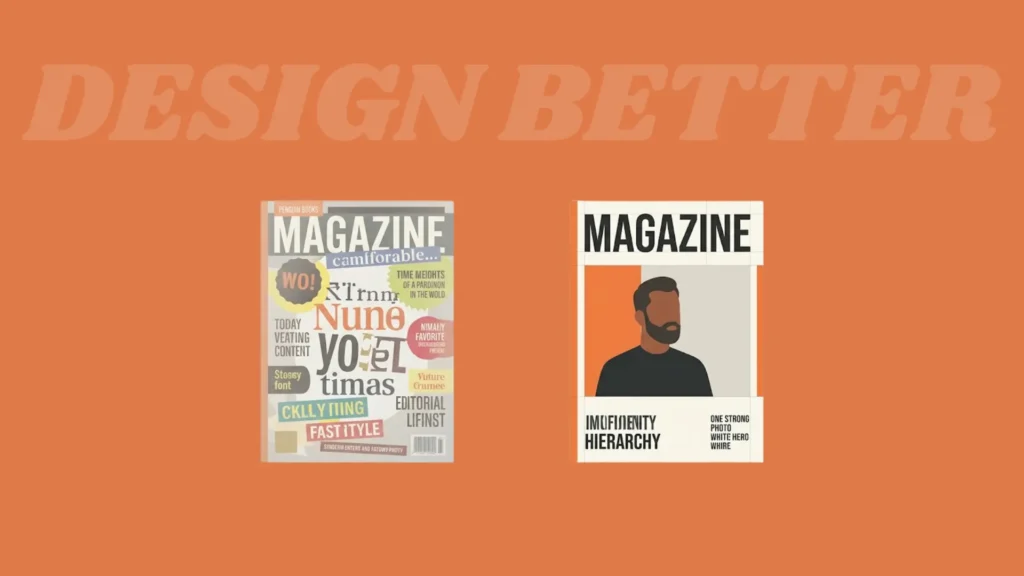
It is the night before the annual magazine goes to print, and somewhere in your school, a student is staring at a blank page with five fonts open in five different tabs. The articles are done. The photos are picked. The editor has already approved the content twice. The only thing left is the cover, and somehow it is the hardest part of the entire project.
This happens almost everywhere, every year. A school magazine can have brilliant writing, thoughtful photography, and genuine effort behind every page, and the cover still ends up looking like an accident. Too many fonts crammed together because nobody could decide on one. Colours that clash instead of complement. A logo squeezed into whatever corner had space left. A title that has to compete with five other elements just to be noticed.
None of this happens because students lack talent. It happens because nobody told them the one thing professional designers have known for almost a century: a cover is not something you create from scratch every time. It is something you build once, properly, and then reuse.
There is a publishing house that figured this out so well, it sold over a billion books worldwide. Studying how they did it will change how you think about your school magazine cover for good.
A Man on a Train Platform
In 1935, a British publisher named Allen Lane was standing on a train platform, looking for something decent to read on his journey. He found nothing. The choices were either cheap, poorly made pulp novels or expensive hardcovers most people could not afford. Nothing good sat in between.
That gap became Penguin Books. Lane’s idea was simple: make books affordable, make them well designed, and make them instantly recognizable, even from a distance, even before anyone read the title.
Here is the part that mattered most. Lane did not ask his designers to make every cover look beautiful on its own terms. He asked them to make every cover belong to the same family. A reader did not need to check the publisher’s name on the spine to know they were holding a Penguin book. The layout itself had become the brand.
That decision is why Penguin still exists, recognisable, nearly a century later. Consistency is what built the trust. Not individual brilliance on a single cover, but the same reliable structure showing up again and again until people stopped questioning it and started expecting it.
The Grid Nobody Sees
By the early 1960s, that consistency had started slipping. Different illustrators were doing their own thing, and Penguin’s covers were drifting apart from each other.
A designer named Romek Marber was brought in to fix it, and instead of redesigning covers one at a time, he built a grid. People now call it the Marber Grid, though calling it a “grid” undersells what it actually did. It was a complete system. The title always sat in the same zone. The illustration always lived in its own dedicated space. The margins never moved. Every image aligned to the same invisible lines.
What makes this worth remembering is not the grid itself. It is what the grid allowed. Thousands of Penguin covers, across every genre imaginable, from murder mysteries to Shakespeare, looked completely different from one another in mood and subject. And every single one of them was unmistakably Penguin.
That is the part most people miss about design systems. They do not flatten creativity. They give creativity somewhere stable to live, so that no matter how different the content is, the family resemblance never disappears.
Why a Grid Makes Designers More Creative, Not Less
This sounds backwards the first time you hear it. Surely a rigid structure limits creative freedom?
In practice, it is the opposite, and the reason is almost embarrassingly simple. Most creative energy on a tight deadline does not go into making bold creative choices. It goes into small, repetitive decisions that have nothing to do with creativity at all. Where should the title sit this year? Top left or centred? Should the logo be bigger or smaller than last year’s? Is this the right shade of blue?
A design system answers all of those questions once, permanently. The title always sits in the same zone. The logo is always the same size, in the same place. The colour palette is already decided. None of that has to be reinvented every single year by a tired student at 11 PM.
What gets freed up is the energy that actually matters: choosing the one photograph that captures the year, writing a title that means something, deciding what story this year’s cover should tell. The system is not the enemy of creativity. It is what protects creativity from being wasted on logistics.
The Skeleton Nobody Prints
If you pulled back the layers of any well-designed magazine or book cover, you would find something the reader never consciously sees: centre lines, diagonals, proportional divisions, alignment guides. None of these lines are ever printed. Nobody points at them. But they are the reason the cover feels balanced instead of chaotic.
Think of it as a skeleton. You never see someone’s skeleton when you look at their face, but without it, nothing would hold its shape. Remove the invisible structure from a cover, and even genuinely good individual elements, a strong photo, a nice font, start to feel messy the moment they are placed together without a plan.
This is the part most school magazines skip entirely, because it is invisible by nature, and invisible things are easy to forget about under deadline pressure.
Why This Keeps Happening Every Single Year
Here is the real reason school magazine covers keep repeating the same mistakes, and it has nothing to do with a shortage of talented students.
It is a memory problem.
Most school magazines are designed once a year, by a group of students who were not around for the previous edition and will not be around for the next one. There is no documentation. No handover. No shared rulebook passed down. Every new team starts from absolute zero, usually under time pressure, usually without any formal design training.
So the same mistakes resurface on a loop. Five or six unrelated fonts. Decorative shadows and glows added because the software made them available, not because the cover needed them. Text dropped directly onto a busy photograph until it becomes unreadable. A logo stretched out of proportion just to fill a gap. Photos cropped without anyone thinking about what the eye lands on first.
The result is a cover where everything is shouting for attention at once. And when everything is shouting, nothing is actually heard.
Five Things to Decide Before You Open a Design Tool
This is the part that actually fixes the problem, and the order matters. Decide these things before anyone touches Canva or Photoshop, not after.
Decide the grid first. Before colours, before photos, sit down and mark out where the logo will always live, where the magazine title sits, where edition details go, where the main photograph belongs, and where the footer information sits. Once this exists on paper, every year after this one simply slots into it.
Choose one photograph, not ten. The instinct to include everyone’s face somewhere on the cover is understandable and almost always wrong. A single strong photograph, well composed, tells a more honest story than a crowded collage ever will. Ask the team one question before anything else: what one image actually represents this year? Usually, there is an obvious answer once someone bothers to ask.
Use size and weight to create order, not colour. Typography is not about finding an interesting font. It is about deciding, in order, what the reader’s eye sees first, second, and third. The magazine title, the school name, the edition, the year, all of it should be obvious through size and spacing alone, even if you removed every colour from the page.
Leave space on purpose. Empty space on a cover is not wasted space. It is what makes the important elements feel important. The instinct to fill every gap with a decorative graphic is the single fastest way to make a cover feel cluttered and amateur. The cleanest covers usually have more empty space than nervous designers feel comfortable with.
Test for recognition, not just beauty. Put your finished cover next to last year’s. Could someone tell, at a glance, that they belong to the same magazine? If a stranger saw it across a room, would they recognize your school’s publication before reading a single word? If the answer is no, the system is not finished yet, even if the individual cover looks fine on its own.
You Are Not the First Organisation to Solve This
Penguin is one example, but it is far from the only one. The same logic shows up everywhere once you start looking for it.
After World War II, Swiss designers built what became known as the Swiss Grid System, based on alignment, consistency, white space, and clarity. Decades later, those same principles quietly shape most modern websites, newspapers, and mobile apps, often without anyone realising where the idea originally came from.
NASA’s graphics manual went even further, specifying exact rules for logo placement, colour, typography, spacing, and photography. At NASA’s scale, an inconsistent design was not just unattractive, it was a genuine risk.
IBM built one of the earliest corporate design systems for a different reason entirely: so that whether someone opened a manual, walked into an office, or used IBM software, the experience felt unmistakably like the same company speaking the same language.
And Apple, even today, rarely reaches for decoration at all. Its products feel premium because of restraint, hierarchy, and consistency, not because of anything added on top.
Different industries, same underlying lesson. Systems build trust faster than individual brilliance ever can.
Building a System Your School Can Actually Keep
None of this requires a design degree or expensive software. It requires one decision: stop redesigning the magazine from zero every year, and start handing down a system instead.
Write the rules down on a single page. The logo always sits in the top-left corner. The title always occupies the top fifth of the page. Only two font families are ever used. The margins stay identical every year. At least sixty percent of the cover is reserved for one hero image. The colour palette stays limited and tied to the school’s own identity, not whatever felt trendy that particular year.
That one page becomes the most valuable document the editorial team owns. Next year’s students inherit it instead of reinventing it, the same way a Penguin designer in 1965 simply used the Marber Grid instead of arguing about layout from scratch.
The Real Lesson Hiding in All of This
Here is the thing that takes a while to sink in. Great design is rarely about making one thing look beautiful in isolation. It is about making the decisions before the design even starts.
Penguin did not become one of the most recognisable publishers on the planet because every single cover was a masterpiece. Plenty of them were quite plain. They became iconic because every cover, plain or striking, clearly belonged to the same family.
A school magazine works the same way. It is not just a collection of articles stapled together once a year. It is a small, repeated statement about who your institution is. Students graduate. Editors move on. Teachers eventually retire. But a well-built visual system can outlive all of them, picked up year after year by people who never even met whoever built it.
That is the actual difference between making a magazine and building something that lasts.
Ten Questions to Ask Before You Send It to Print
Before the final file goes to the printer, sit with these honestly.
- Is there one clear focal point on the cover?
- Does the title genuinely lead the page, or is it competing for space?
- Are only one or two fonts in use?
- Does the layout feel balanced rather than crowded?
- Is there enough breathing room between elements?
- Is everything aligned to a grid, or placed by eye and instinct?
- Would someone recognize this as your magazine from across a room?
- Does every decorative element on the page actually serve a purpose?
- Would the cover still hold up if printed in plain black and white?
- Will next year’s cover feel like a sibling to this one, or like a stranger?
If the honest answer is yes across the board, your school’s magazine is already ahead of most student publications, and a fair number of professional ones too.
Because the truth, as boring as it sounds, is this: the best covers are almost never the product of a sudden burst of inspiration. They are the product of a system, built carefully once, and trusted every single year after.

