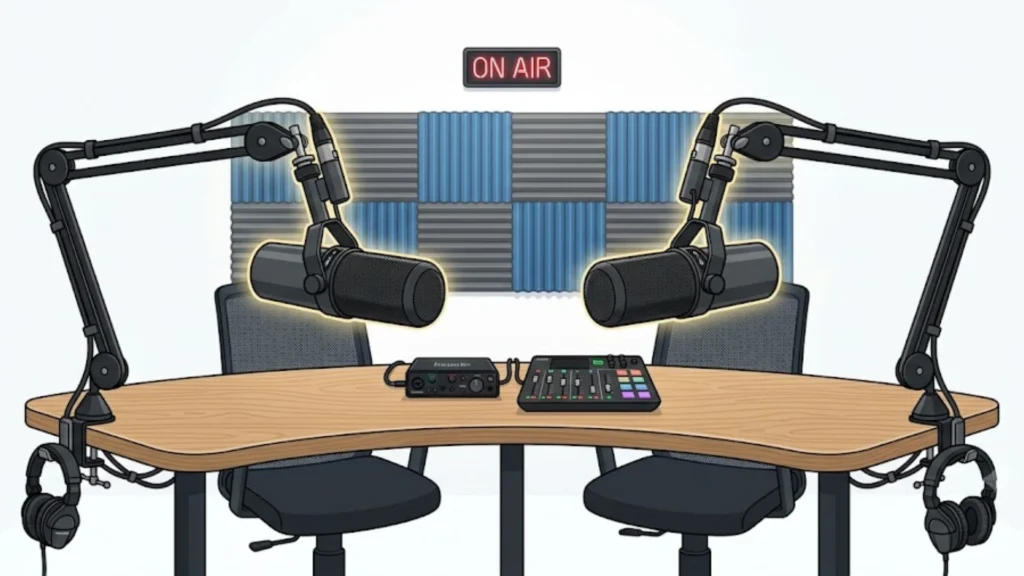
There is a strange thing about podcasts: the more of them we have, the harder it becomes to make one matter. Today, almost anyone can get a great guest, record in a beautiful studio, produce cinematic video and distribute it everywhere. Yet most conversations disappear almost as quickly as they appear. Perhaps the problem is not the quality of the conversation at all. Perhaps we are asking the wrong question. We tend to ask, “Who should we invite?” or “What should we talk about?” when the more fundamental question is: why should anyone give us an hour of their attention? That is where positioning begins. And podcasting is simply one of the clearest examples of a much larger problem every brand, organisation and leader faces: when everyone has the ability to create, what makes someone worth listening to?
Table of Contents
A podcast is not a format; it is a promise
The easiest way to misunderstand a podcast is to think of it as a format. Put two people in a room, turn on the cameras, have an interesting conversation and publish it. That is a podcast, technically. But it tells us almost nothing about why anyone should listen to it.
“Conversations with interesting people” sounds reasonable until you realise that thousands of podcasts can make exactly the same promise. So can YouTube channels, business magazines, television interviews and increasingly, AI-generated content.
The format is therefore not the proposition.
A podcast becomes interesting when it makes a particular promise to a particular audience. It might promise access to people they would otherwise never hear from. It might promise an unusually deep understanding of complex subjects. It might promise entertainment and discovery. It might promise an honest look at how powerful people actually think. Whatever the promise is, the audience should be able to answer a simple question: why this show?
That distinction is easy to overlook because podcasting gives creators an abundance of things to talk about. But abundance is precisely the problem. When content is scarce, simply having something interesting to say can be enough. When content is everywhere, the audience needs a reason to choose one source over another.
This is why positioning matters more than production.
The first question is not “What will we talk about?”
When people plan a podcast, they often begin with their own inventory. We have access to CEOs. We know economists. We can invite founders. We have a good studio. We can get celebrities.
These are useful assets, but they are not a position.
A better starting point is the audience’s curiosity.
What does someone genuinely want to understand? What question keeps appearing in their life, their work or the news, but remains poorly explained? What is widely discussed but insufficiently understood?
Consider the difference between saying that a podcast is about the Indian economy and saying that it is trying to understand what is actually happening underneath India’s headline economic growth.
The first is a category.
The second is an investigation.
That distinction creates enormous room for editorial judgment. It allows you to ask why rural consumption is behaving differently from urban consumption, why employment and income growth do not always move together, why manufacturing growth does not automatically translate into large-scale job creation, or why a country can post impressive macroeconomic numbers while households still feel financially stretched.
The subject has not changed. The question has.
And questions are much more powerful foundations for media brands than categories because a good question can survive hundreds of episodes.
The best podcast questions contain a tension
The questions that produce the strongest conversations are rarely purely informational. They contain some form of contradiction.
India is growing, but are Indians becoming richer?
AI is making companies more productive, but what happens to the people whose work is being automated?
Entrepreneurs want freedom, but why do successful founders often become prisoners of the companies they built?
People say they want work-life balance, but why do ambitious professionals repeatedly choose environments that make it impossible?
A tension creates a gap between what we think we know and what might actually be true. That gap is where curiosity lives.
This is one reason a podcast should not merely tell the audience what an episode is about. It should give them a reason to want the answer.
There is a subtle but important difference between information and curiosity. “How India’s manufacturing sector is growing” gives you information about the subject. “India is manufacturing more. So why aren’t jobs exploding?” creates a problem in the listener’s mind.
The second is much harder to ignore.
The guest should illuminate the question, not become the question
The obsession with guests is perhaps the most visible consequence of weak podcast positioning.
A famous person can certainly help a show get discovered. But fame is not the same thing as value.
If the entire proposition of a podcast is that it gets famous people to talk, it becomes vulnerable to a simple problem: once everyone has access to famous people, what remains distinctive?
A better approach is to think of the guest as someone who possesses a piece of the answer.
Imagine interviewing the CEO of a large company. One podcast might ask about their childhood, career and entrepreneurial journey. Another might ask what they got wrong while scaling. A third might investigate the incentives inside large organisations that cause intelligent people to make poor decisions.
The same person can produce three completely different conversations.
The difference is not the guest. It is the lens through which the guest is being examined.
This is where a podcast begins to develop a real editorial identity.
Your lens is what makes the same world look different
Every serious media brand eventually develops a way of looking at the world.
Some are obsessed with data. Others look for power. Some look at incentives. Others focus on psychology, history, technology or human behaviour.
Two publications can cover the same event and leave readers with completely different understandings because they ask different questions.
The same is true of podcasts.
A business podcast might ask, “What happened?”
A more analytical show might ask, “Why did it happen?”
A systems-oriented show might ask, “What incentives produced this outcome?”
A contrarian show might ask, “What if the conventional explanation is wrong?”
The topic gives you relevance, but the lens gives you differentiation.
This is also why a strong host can eventually become more important than the original topic.
How a niche podcast earns the right to become broad
One of the most interesting examples is Joe Rogan.
Joe Rogan can move from MMA to comedy, science, politics, psychology or culture without the show feeling completely disconnected from itself. On the surface, there is little obvious topical consistency.
The consistency is the host.
The audience has learned what a conversation with Rogan is likely to feel like: long, exploratory, informal and driven by curiosity. The subject can change because the underlying experience remains recognisable.
But that is an important distinction for anyone starting a podcast.
A new host cannot begin with the assumption that people are interested in their curiosity. They have not earned that privilege yet.
This suggests a useful progression for podcast brands. They often begin topic-led, become question-led, and, if they succeed, eventually become host-led or worldview-led.
In the beginning, the audience may arrive because they care about economics. They stay because the questions are better than elsewhere. Eventually, they may come simply because they trust the host to make almost any subject interesting.
The objective is therefore not to remain niche forever.
The objective is to use specificity to earn trust and then use that trust to expand.
The real product is a change in understanding
There is another way to judge whether a podcast is actually valuable.
Forget the guest list. Forget the episode length. Forget the production quality.
Ask what is different in the listener’s mind at the end.
A strong episode should create some form of mental movement.
The listener begins with one interpretation and leaves with another.
“I thought India’s employment problem was simply about the number of jobs. Now I understand that the quality and productivity of those jobs may matter just as much.”
“I thought AI would simply eliminate certain professions. Now I understand that it may first change the economics and structure of those professions.”
“I thought this founder succeeded because of a brilliant idea. Now I understand the organisational system and incentives that allowed the idea to scale.”
That movement is the actual value of the conversation.
The best podcast episodes do not necessarily give the listener a list of five takeaways. They leave them with a better mental model.
And that is a much more durable form of value.
Positioning should make the next hundred episodes easier
A useful test of a podcast position is not whether it sounds clever when written in a pitch deck. It is whether it makes editorial decisions easier six months later.
Suppose a show is positioned around understanding what is really happening beneath India’s biggest economic and business stories.
That single idea can generate hundreds of questions. Why is consumption changing? Why are wages behaving differently from GDP? Why are Indian companies investing in AI? Why are young people delaying home ownership? Why are certain businesses thriving while others are struggling?
The positioning does not tell you what every episode must be.
It tells you which episodes belong.
That is the difference between a theme and an editorial engine.
A good position creates constraints, but useful constraints are not the enemy of creativity. They are what make creativity coherent.
The three different jobs a podcast has to perform
There is also a useful distinction between getting someone to discover an episode, getting them to listen and getting them to return.
The first is often driven by the guest, the headline, the thumbnail or a provocative idea. A famous guest might get someone to click.
The second is driven by the quality of the conversation. The questions, storytelling, tension, personality and pacing determine whether the listener stays.
The third is driven by trust.
Why should they come back next week?
That is where positioning becomes important.
A guest can create discovery. A great conversation can create satisfaction. But a distinctive editorial identity can create loyalty.
This is why a podcast cannot build its entire brand around the names appearing on its guest list. Guests change. The underlying promise should not.
What podcasting teaches us about strategy
This is ultimately why the question of podcast positioning is much bigger than podcasting.
Every organisation operates in a world where alternatives are abundant. Every company has competitors. Every publication has substitutes. Every professional competes for attention. Every leader is trying to persuade people to care about something.
The fundamental strategic question is always similar:
Why should anyone choose us?
The answer cannot simply be that we have good people, good technology, good access or good production. Those are capabilities.
The deeper answer is what those capabilities allow us to consistently deliver that others do not.
Podcasting makes this unusually visible because the cost of switching is almost zero. A listener can leave your episode and instantly find another one. There is no shortage of alternatives.
That forces a useful discipline: make the promise clear.
Who is this for? What question are we trying to answer? What is our lens? Why are we uniquely equipped to explore it? And what will the listener understand differently when the conversation ends?
If those answers are unclear, adding more guests or improving the studio rarely solves the underlying problem.
The simplest way to think about podcast positioning
A useful way to bring all of this together is to think of positioning as five connected decisions.
First, the audience: whose curiosity are we serving?
Second, the question: what are we repeatedly trying to understand?
Third, the lens: what do we notice or investigate differently?
Fourth, the access: who can help us uncover the answer?
And finally, the payoff: what does the listener understand, question or see differently after listening?
When those five things align, the podcast starts to feel inevitable. The guests make sense. The questions make sense. The episodes make sense. Even the decision to broaden into new subjects can make sense.
More importantly, the audience begins to understand what they are subscribing to.
Not a topic.
Not a guest.
Not even a format.
An experience of seeing something differently.
That may be the most important lesson of podcasting in the age of infinite content.
When anyone can create, content stops being the differentiator.
When everyone can access interesting people, access stops being enough.
When everyone can produce high-quality video, production stops being a moat.
What remains scarce is attention.
And attention is earned when you can answer, with unusual clarity:
Why should I spend my time with you?
That is positioning.
And for a podcast, it may be the most important decision you make.