
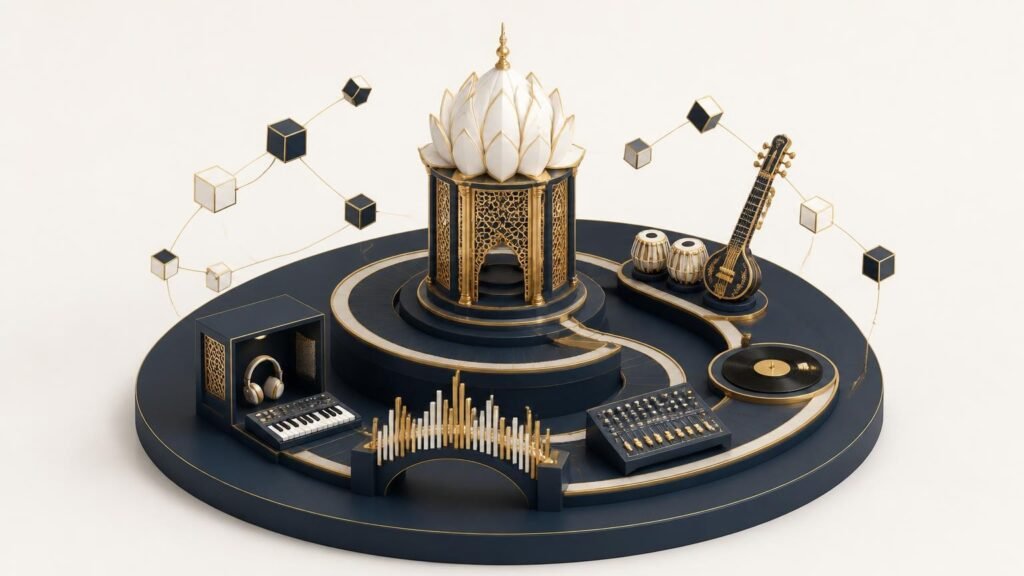
What Does a Music Producer Actually Do?
A music producer is the creative and technical architect behind a finished track. While a singer or instrumentalist performs the parts and an audio engineer focuses on capturing clean sound, the producer shapes the song’s arrangement, rhythm, sonic identity, and emotional impact from raw demo to release-ready master.
In India’s fast-expanding audio ecosystem—spanning Bollywood and regional film industries, independent streaming artists, OTT background scores, advertising jingles, podcasts, and gaming—producers often wear multiple hats. Depending on your niche, your day-to-day work can include:
- Arrangement and Programming: Building drum grooves, synth layers, and virtual instrument arrangements inside a Digital Audio Workstation (DAW).
- Recording Direction: Coaching vocalists and session musicians in the studio to capture the best emotional take.
- Sound Design and Synthesis: Creating signature textures, transitions, and sonic branding for tracks, films, or commercials.
- Mixing and Pre-Mastering: Balancing levels, EQ, compression, and spatial effects so a track translates cleanly across headphones, club systems, and mobile speakers.
Core Skills and Technical Foundations You Need
You do not need a formal degree to start producing music, but you do need a disciplined blend of musicality, technical fluency, and people skills. Clients hire producers who deliver broadcast-ready quality on tight deadlines.
- Practical Music Theory: Understanding scales, chord progressions, rhythm, tempo, and song structure (verse, pre-chorus, chorus, bridge). Familiarity with both Western harmony and Indian melodic frameworks (ragas and talas) gives you a strong edge in the Indian market.
- DAW Mastery: Pick one primary DAW and learn it deeply before exploring others. Industry standards in India include Logic Pro (widely used in Mumbai film and pop studios), Ableton Live (dominant in electronic and indie music), FL Studio (popular for hip-hop and beat-making), and Pro Tools (standard for studio recording and post-production).
- Critical Listening and Acoustics: Training your ears to spot frequency clashes, phase issues, and stereo balance—paired with basic room treatment so your monitors tell you the truth.
- Collaboration and Project Management: Managing stems, version control, client revisions, and vocal sessions professionally.
Education Pathways and Top Music Production Institutes in India
Aspiring producers in India usually take one of two routes: self-directed learning paired with mentorship, or structured training at a dedicated music and audio institute. Formal courses accelerate your technical growth, give you hands-on access to treated studios, and plug you into an alumni network.
Notable institutions offering music production and sound engineering programmes in India include:
- KM Music Conservatory (KMMC), Chennai: Founded in 2008 by the A.R. Rahman Foundation, KMMC offers full-time Foundation and Diploma programmes alongside focused Music Production courses (including a 6-month Music Production programme at ₹1.5 lakh + GST, a 9-month Music Production + Live programme at ₹2.5 lakh + GST, and a 3-month online programme at ₹99,000 + GST).
- The True School of Music (Vijaybhoomi University), Mumbai/Karjat: Known for contemporary music production, sound engineering, and industry-oriented degree and certificate tracks.
- Whistling Woods International, Mumbai: Offers degree and diploma programmes in music production and composition with strong exposure to film and OTT workflows.
- Swarnabhoomi Academy of Music (SAM), Chennai: Focuses on contemporary performance, composition, and production with international faculty.
- Film and Television Institute of India (FTII), Pune: Ideal if you are drawn specifically to sound recording, sound design, and film audio post-production.
Before enrolling anywhere, check studio hours per student, faculty credits, and whether the curriculum includes real mixing and recording projects rather than purely classroom theory.
Building a Starter Home Studio Without Overspending
One of the biggest traps for beginners is spending lakhs on gear before mastering fundamentals. A lean, reliable bedroom setup costing between ₹60,000 and ₹1.5 lakh is more than enough to produce commercial-grade tracks.
- Computer: A reliable laptop or desktop with at least 16 GB RAM and an SSD to run heavy virtual instruments and plugins smoothly.
- Audio Interface: A clean 2-in/2-out USB interface (such as Focusrite Scarlett or Audient iD series) for low-latency recording.
- Monitoring: A pair of flat-response studio headphones (for untreated rooms) plus entry-level 5-inch studio monitors once you add basic acoustic panels.
- Microphone and MIDI Controller: One large-diaphragm condenser microphone for vocals and acoustic instruments, paired with a 49-key or 61-key MIDI keyboard.
Invest in acoustic treatment (broadband absorption panels and bass traps) before upgrading to expensive microphones or plugins—a treated room instantly improves every recording and mix decision you make.
Step-by-Step Roadmap to Land Your First Paid Projects
Talent alone rarely builds a career in music; visibility, consistency, and trust do. Follow a structured progression over your first 12 to 24 months:
- Build a Focused Portfolio (5–8 Tracks): Create a tight reel showcasing your strongest 2–3 genres rather than 30 unfinished beats. Include full productions with vocals—clients want to hear how you handle a voice.
- Collaborate with Emerging Vocalists and Songwriters: Partner with independent artists, college bands, and YouTube creators to release finished songs on Spotify, Apple Music, and YouTube.
- Assist at an Established Studio: Working as an assistant producer or junior studio engineer in Mumbai, Bengaluru, Chennai, Delhi NCR, or Hyderabad teaches you session etiquette, signal flow, and how real commercial briefs are executed.
- Diversify Beyond Film Songs: Pitch to ad agencies, podcast networks, indie filmmakers, and D2C brands that need fast-turnaround background scores, sonic logos, and audio post-production.
- Understand Rights and Contracts: Learn the difference between work-for-hire buyouts, master royalties, and publishing splits. Register with Indian copyright societies such as IPRS (Indian Performing Right Society) once you begin releasing commercial work.
Career Paths and Earning Potential in India
Income in music production is rarely linear—it scales with your portfolio, speed, and client network rather than years of experience alone. Most full-time producers in India combine two or more of the following revenue streams:
- Independent & Commercial Music Production: Charging per-track production fees for indie artists, regional labels, or film music directors (ranging from ₹10,000–₹25,000 per track for newcomers to ₹1 lakh+ per track for established producers).
- Advertising, OTT, and Background Scoring: Composing jingles, digital ad scores, and web-series cues—often one of the most reliable cash-flow streams in metro cities.
- Mixing, Mastering, and Session Programming: Offering specialized technical services to other composers and independent artists globally via remote workflows.
- Sync Licensing and Royalties: Licensing original instrumentals to stock libraries, brands, games, and streaming platforms for recurring passive income.
- Salaried Studio & Media Roles: Working full-time as an in-house producer, sound designer, or audio engineer at media houses, gaming studios, edtech platforms, or radio networks (typically starting around ₹3.5 lakh–₹6 lakh per annum and scaling with specialization).
Frequently Asked Questions
Do I need a degree to become a music producer in India?
No. The Indian music industry hires primarily on the strength of your portfolio, technical reliability, and studio reputation. However, a structured certificate or diploma from a reputed institute can speed up your learning curve and help you build early industry connections.
Which DAW is best for beginners in music production?
Logic Pro (for macOS), Ableton Live, and FL Studio (for Windows and macOS) are the most beginner-friendly yet industry-ready choices. Pick one based on your computer and preferred genre, and focus on mastering it completely before switching.
Can I start a music production career without playing an instrument?
Yes, many modern producers begin by programming beats and melodies using a mouse and MIDI controller. Learning basic keyboard skills and chord theory over time, however, makes composing faster and improves communication with session musicians.
How much does it cost to set up a basic home studio in India?
Excluding a computer, you can build a solid starter setup—audio interface, studio headphones, condenser microphone, and MIDI keyboard—for roughly ₹40,000 to ₹80,000. Including a capable laptop and basic acoustic treatment, budget around ₹1.2 lakh to ₹1.8 lakh.
Which cities in India have the most opportunities for music producers?
Mumbai remains the largest hub for Bollywood, advertising, and OTT scoring, followed by Chennai and Hyderabad for South Indian film industries, and Bengaluru and Delhi NCR for independent music, live electronics, gaming, and brand audio.
How long does it take to start earning as a music producer?
With consistent daily practice, most dedicated learners can produce release-ready tracks and start taking small paid projects (indie artists, podcasts, local ads) within 12 to 18 months, while building a full-time sustainable income typically takes 2 to 4 years.
