
Every teacher has written a parent-teacher meeting (PTM) email that takes longer than it should. You know what needs to be communicated, but the message becomes a collection of observations, explanations, concerns, and requests. By the time the parent reaches the end, the most important point may have been lost.
The challenge is not necessarily your writing ability. It is the structure of your thinking.
What if you could write an email that communicates the main message in the first two sentences, explains the reasons in a logical order, and gives parents a clear action to take?
This is where The McKinsey Pyramid Principle, developed by Barbara Minto, becomes useful. Originally designed to improve structured business communication, the framework can also help teachers, school leaders, and academic coordinators write more effective PTM emails.
In this guide, we will break down the framework, explain how to apply it to parent-teacher communication, and provide a reusable email structure with practical examples.
Table of Contents
1. What Is the McKinsey Pyramid Principle?
The Pyramid Principle is a communication framework developed by Barbara Minto, a former McKinsey consultant. It helps writers organize their thinking before communicating their ideas.
The central idea is simple: present your main conclusion first, then support it with logically grouped arguments and evidence.
Instead of making the reader work through a long explanation to discover the point, you give them the answer immediately and then explain why it matters.
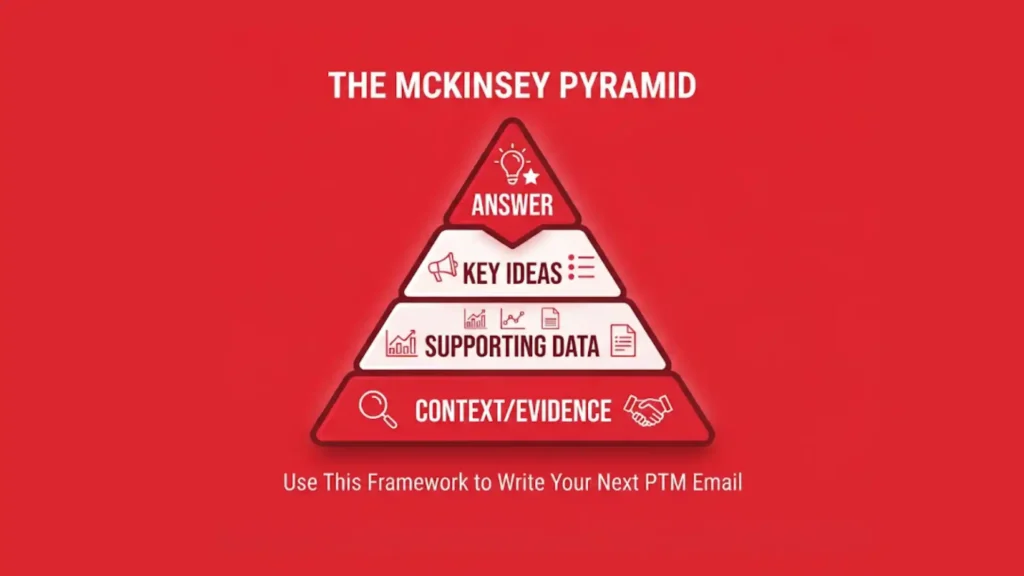
Barbara Minto’s framework organizes ideas into a hierarchy. The main message sits at the top, supporting arguments sit beneath it, and evidence supports those arguments at the next level.
How the pyramid structure works
                MAIN MESSAGE
                     |
        -------------------------
        |           |           |
      Reason 1    Reason 2    Reason 3
        |           |           |
      Evidence    Evidence    Evidence
Imagine a teacher writing to a parent about a student’s declining academic performance.
A conventional email might begin with attendance details, classroom observations, homework records, and test scores. The parent has to read everything before understanding the concern.
A pyramid-structured email begins with the conclusion:
Your child would benefit from a structured revision plan over the next four weeks to improve performance in Mathematics.
The teacher can then explain the supporting reasons: inconsistent practice, difficulty with algebraic concepts, and errors in the latest assessment.
The parent immediately understands the purpose of the email. The supporting details explain the recommendation rather than delaying it.
2. Why the Pyramid Principle Works for PTM Emails
Parent-teacher communication is different from ordinary business communication. Teachers are discussing a child’s academic progress, behaviour, emotional development, and learning needs. The communication must be clear without becoming impersonal.
The Pyramid Principle can help address three common challenges.
Challenge 1: Parents may not have time to read long emails
Parents often receive messages from schools about examinations, attendance, activities, academic progress, and administrative requirements.
A well-structured email allows a parent to identify the purpose quickly. Even if they read only the opening paragraph, they should understand the essential message.
Challenge 2: Teachers need to communicate sensitive feedback
Academic concerns can be difficult to communicate. A message about incomplete homework or declining performance may sound accusatory if it is poorly structured.
Leading with a constructive recommendation creates a more collaborative tone. The teacher can then explain the observations that support the recommendation.
Challenge 3: Emails need to lead to action
A PTM email should not simply describe a problem. It should help the parent understand what happens next.
For example, a message about poor attendance should clarify whether the parent needs to attend a meeting, provide documentation, or discuss a support plan.
The Pyramid Principle makes the action easier to identify because the email is organized around a central message.
3. The Four-Part Framework for a Powerful PTM Email
You do not need to build a complicated pyramid every time you write to a parent. A practical adaptation of the principle can be organized into four parts.
- Conclusion: What is the main message?
- Supporting reasons: Why are you communicating this?
- Evidence: What specific observations support the message?
- Action: What should the parent do next?
Part 1: Start with the conclusion
The first sentence should communicate the purpose of the email. Avoid opening with a lengthy background explanation.
Weak opening:
I hope you are doing well. I wanted to bring to your attention some observations regarding your child’s academic performance over the last few weeks.
Stronger opening:
I would like to discuss a focused revision plan for your child’s upcoming Mathematics assessment.
The stronger opening tells the parent what the email is about without unnecessary introductory language.
Part 2: Group the supporting reasons
After stating the main message, explain the two or three most important reasons behind it.
For example, if a student needs academic support, the reasons might be:
- Difficulty applying concepts independently.
- Inconsistent completion of practice assignments.
- Repeated errors in assessment questions.
These are illustrative categories. The actual reasons should come from the teacher’s observations and available academic records.
Grouping related information helps the parent understand the overall pattern rather than receiving a disconnected list of complaints.
Part 3: Support your reasons with evidence
Specific observations make an email more credible and useful.
Compare these two statements:
General statement: Your child needs to improve in Mathematics.
Evidence-based statement: In the last two classroom assessments, your child experienced difficulty solving algebraic equations independently, particularly when questions required multiple steps.
The second statement gives the parent something concrete to understand and discuss.
Use only verified information. Avoid assumptions about a child’s motivation, home environment, or learning ability unless these have been appropriately established.
Part 4: End with a clear action
The final part of the email should explain what happens next.
Examples include:
- Please confirm your availability for the scheduled PTM.
- Please review the attached revision plan with your child.
- Please share any relevant information that may help us support your child’s learning.
- Please meet the Mathematics teacher during the scheduled PTM slot.
A good action statement is specific, realistic, and easy to respond to.
4. The Situation-Complication-Question Framework
The Pyramid Principle is also associated with a useful way of identifying the question a document needs to answer: Situation, Complication, and Question (SCQ).
SCQ helps the writer understand the context before developing the main message.
Situation: What is already known?
Begin by identifying the context that the parent and teacher share.
Example: The student has been attending regular Mathematics classes and is preparing for the upcoming assessment.
Complication: What has changed or become difficult?
Identify the issue that requires attention.
Example: Recent assessments indicate that the student is struggling to apply algebraic concepts independently.
Question: What does the parent need to know?
Determine the central question your email must answer.
Example: What steps can the school and parent take together to improve the student’s performance?
The answer becomes the main message at the top of the pyramid:
A four-week revision plan, supported by regular practice and teacher feedback, would help address the student’s current learning gaps.
The SCQ framework is a thinking tool. It does not mean that every PTM email must contain three separate paragraphs labelled Situation, Complication, and Question.
5. A Complete PTM Email Example Using the Pyramid Principle
Consider a hypothetical situation where a student has shown inconsistent performance in Mathematics.
The following example demonstrates how to organize the message from the conclusion to the supporting evidence and action.
Example: Academic support email
Subject: PTM Discussion: Mathematics Revision Plan for [Student Name]
Dear [Parent Name],
I would like to discuss a focused revision plan for [Student Name] to strengthen their understanding of algebraic concepts before the upcoming Mathematics assessment.
Recent classroom observations indicate that additional support may be helpful in three areas:
- Applying algebraic concepts independently.
- Solving multi-step problems accurately.
- Completing practice assignments consistently.
In the recent classroom assessments, [Student Name] demonstrated difficulty with questions that required multiple steps. Regular practice and targeted revision may help address these learning gaps.
During the upcoming PTM, I would like to discuss a four-week revision plan that includes regular practice, classroom feedback, and a review of progress.
Please confirm your availability for the scheduled PTM. I look forward to working together to support [Student Name]’s learning.
Regards,
[Teacher Name]
[School Name]
Why this email works
- The conclusion comes first: The parent immediately understands the purpose of the email.
- The reasons are grouped: The teacher identifies three areas requiring support.
- The evidence is specific: The email refers to observed assessment difficulties rather than making a general judgment.
- The action is clear: The parent is asked to confirm availability for the PTM.
- The tone is collaborative: The teacher presents the issue as an opportunity to work together.
6. How to Apply the Framework to Different PTM Scenarios
The Pyramid Principle is flexible. The main message changes depending on the purpose of the email, but the underlying structure remains consistent.
Scenario 1: Inviting parents to a routine PTM
Main message: The school is inviting parents to discuss the student’s academic and developmental progress.
Supporting information: The meeting will cover academic performance, classroom participation, and areas for improvement.
Action: Confirm attendance and select the available meeting slot.
Example opening:
We invite you to attend the upcoming Parent-Teacher Meeting to discuss [Student Name]’s academic progress, classroom participation, and learning goals.
Scenario 2: Discussing declining academic performance
Main message: A focused academic support plan would help address the student’s current learning gaps.
Supporting information: Recent assessment results, classroom observations, and assignment completion records.
Action: Discuss the support plan during the PTM and agree on the next steps.
Example opening:
I would like to discuss a focused academic support plan for [Student Name] following recent assessments that indicate difficulty with specific concepts.
Scenario 3: Addressing attendance concerns
Main message: The student’s attendance pattern requires a discussion to ensure continuity in learning.
Supporting information: Verified attendance records and the dates of missed classes.
Action: Discuss the attendance pattern and any support or documentation required.
Example opening:
I would like to discuss [Student Name]’s recent attendance pattern and understand how we can support consistent participation in classroom learning.
Scenario 4: Communicating positive academic progress
The Pyramid Principle is equally useful for positive communication. The main message should highlight the achievement rather than burying it among routine observations.
Main message: The student has demonstrated meaningful progress in a particular area.
Supporting information: Improved assessment performance, increased classroom participation, or consistent completion of assignments.
Action: Encourage the student to continue the practices contributing to this progress.
Example opening:
I am pleased to share that [Student Name] has demonstrated encouraging progress in classroom participation and independent problem-solving over the past few weeks.
7. Common Mistakes to Avoid When Writing PTM Emails
Even when the Pyramid Principle is understood, certain writing habits can weaken the message.
Starting with unnecessary background
A long introduction delays the central message. Keep greetings brief and communicate the purpose early.
Listing observations without a conclusion
Three observations do not automatically create a useful message. Explain what those observations mean and why they matter.
Using vague language
Statements such as “needs improvement” or “must work harder” do not explain what the student needs to improve. Use specific, observable behaviours or learning outcomes.
Making the email sound accusatory
Focus on the learning need rather than labelling the student. For example, “The student would benefit from additional practice” is more constructive than “The student is careless.”
Including too many details
Not every observation belongs in the email. Select the information that supports the main message. Additional details can be discussed during the PTM.
Ending without a next step
A parent should not have to guess whether a response is required. State the action, deadline, or meeting requirement clearly.
8. A Reusable PTM Email Template
Use the following structure whenever you need to write a parent-teacher communication email.
Subject: [Purpose of Email] | [Student Name]
Dear [Parent Name],
Main message: I would like to discuss [main concern, achievement, or recommendation] regarding [Student Name].
Supporting reasons: The key observations are [Reason 1], [Reason 2], and [Reason 3].
Evidence: These observations are based on [assessment records, classroom observations, attendance records, or other verified information].
Action: During the upcoming PTM, I would like to discuss [specific action or support plan]. Please [confirm availability, review the attached document, or respond with the required information].
Thank you for your support and collaboration.
Regards,
[Teacher Name]
[School Name]
This template is a starting point, not a rigid formula. Adjust the length, tone, and level of detail to suit the purpose of the email and the sensitivity of the issue.
9. A Practical Checklist Before Sending Your PTM Email
Before sending an email to a parent, review it against the following checklist.
- Does the first paragraph communicate the main message?
- Can the parent understand the purpose without reading the entire email?
- Are the supporting reasons logically grouped?
- Are the observations factual, specific, and verified?
- Does the email avoid unnecessary jargon and accusatory language?
- Is the requested action clearly stated?
- Have the student’s name, parent details, dates, and meeting information been checked?
- Does the email protect the student’s privacy and maintain a professional tone?
If the answer to these questions is yes, the email is likely to be clearer and more useful to the parent.
10. Frequently Asked Questions
What is the McKinsey Pyramid Principle?
The McKinsey Pyramid Principle is a structured communication framework developed by Barbara Minto. It organizes ideas hierarchically, placing the main conclusion at the top and supporting arguments and evidence beneath it.
How can teachers use the Pyramid Principle in PTM emails?
Teachers can use the framework by stating the purpose of the email first, grouping the supporting observations, providing relevant evidence, and ending with a clear action for the parent.
What is the difference between the Pyramid Principle and SCQ?
The Pyramid Principle organizes the message around a central conclusion and supporting arguments. SCQ, which stands for Situation, Complication, and Question, helps the writer identify the context and the question the communication needs to answer.
Should every PTM email follow the same structure?
The underlying logic can remain consistent, but the email should be adapted to its purpose. A routine meeting invitation may require only a few sentences, while a sensitive academic concern may need more context and supporting evidence.
How long should a PTM email be?
There is no universal word limit. A useful PTM email should be as short as possible while still communicating the main message, relevant supporting information, and next steps. More complex matters may require a longer email or a separate meeting.
Is the Pyramid Principle an official McKinsey PTM email format?
No. The Pyramid Principle is a communication framework developed by Barbara Minto and associated with structured business writing. The PTM examples in this article are practical adaptations for educational communication, not official McKinsey templates.
Conclusion: Structure Your Thinking Before You Structure Your Email
A good PTM email does more than communicate information. It helps a parent understand what matters, why it matters, and what can be done next.
The McKinsey Pyramid Principle offers a practical way to achieve this. Start with the conclusion, organize the supporting reasons, use evidence to explain your observations, and finish with a clear action.
For teachers, this approach can make parent communication more focused and constructive. For school leaders, it can provide a consistent foundation for professional communication across the institution.
The next time you write a PTM email, do not begin by asking, “What should I write first?”
Instead, ask: “What is the one message the parent must understand?”
Once you have that answer, the rest of the email becomes much easier to write.