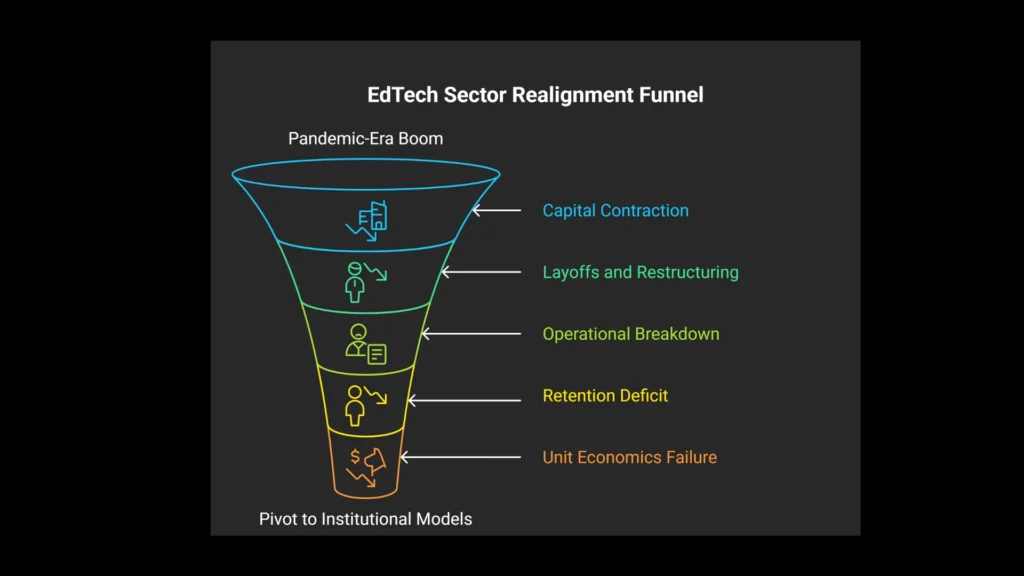
The global and Indian educational technology sectors are undergoing a profound structural realignment following the collapse of the pandemic-era digital learning boom. Capital deployment into Indian EdTech platforms reached an unsustainable zenith in 2021 before experiencing a systemic contraction, with total venture funding falling from USD 2.6 billion in 2022 to USD 297.3 million in 2023. This macro liquidity contraction triggered over 14,000 corporate layoffs and exposed the structural vulnerabilities of consumer-facing direct-to-consumer (B2C) EdTech models. Prominent platforms that relied heavily on venture capital to fund paid customer acquisition have faced insolvency, restructuring, or severe valuation write-downs. For example, Unacademy saw its transaction valuation compressed from USD 3.5 billion to approximately USD 218 million during strategic consolidation discussions, while market leaders like BYJU’S entered insolvency proceedings.
At the core of this sectoral failure is the operational breakdown of pure-play live and pre-recorded online course delivery. EdTech firms scaled under the faulty assumption that broadcasting video content was equivalent to delivering educational outcomes. Quantitative learning benchmarks reveal that self-paced online courses achieve an average completion rate of just 38%, a figure that drops to 29% when excluding employer-mandated corporate training. On unmoderated public platforms such as India’s SWAYAM portal, course completion rates fall below 4%. Without structured peer accountability, human mentorship, or adaptive diagnostic feedback loops, static video platforms induce an illusion of learning while failing to generate verifiable skill acquisition or exam selection outcomes.
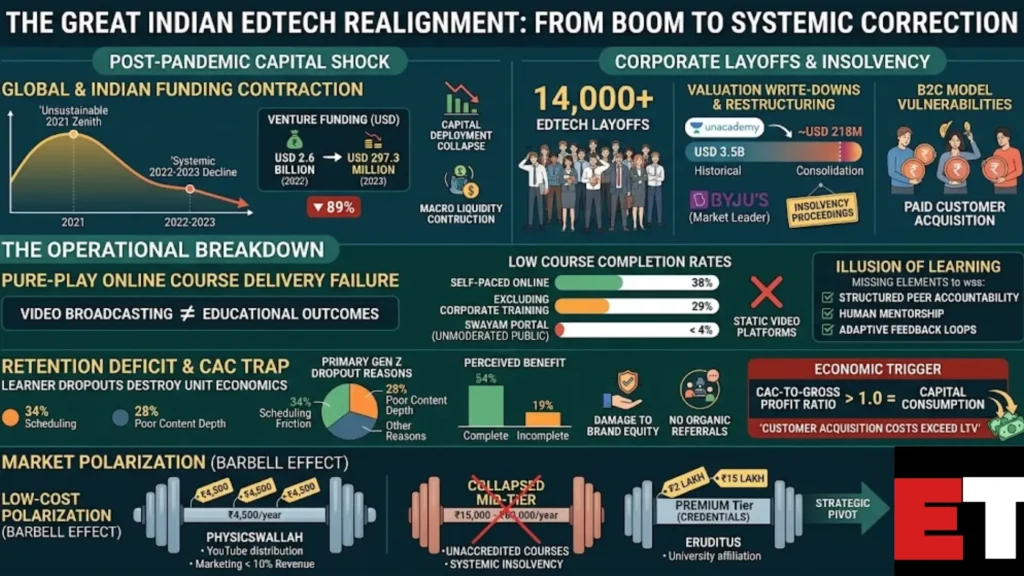
This retention deficit directly breaks the underlying unit economics of B2C platforms. Learner dropouts are driven primarily by scheduling friction, which accounts for 34% of Gen Z dropouts, and poor content depth, which accounts for 28%. When a learner fails to complete a course, their perceived career or academic benefit drops from 54% down to 19%, permanently damaging brand equity and eliminating organic referral channels. As a consequence, platforms become trapped in performance marketing bidding wars to replace churning users, driving Customer Acquisition Costs (CAC) to levels that exceed student Lifetime Value (LTV). When the CAC-to-Gross Profit ratio rises above 1.0, direct-to-consumer course sales consume more capital than they generate.
Concurrently, a price compression barbell effect has eliminated the profitability of mid-tier EdTech courses. Low-cost operators like PhysicsWallah leveraged massive organic distribution via YouTube to reduce marketing costs below 10% of total revenue, pricing annual joint entrance exam prep bundles at ₹4,500. On the opposite end of the spectrum, premium executive education providers like Eruditus command ₹2 Lakh to ₹15 Lakh for university-affiliated credentials. Mid-market EdTech operators attempting to sell unaccredited online courses between ₹15,000 and ₹60,000 per year without guaranteed outcome metrics have faced systemic insolvency, forcing equity holders to pivot toward high-margin institutional business models.