
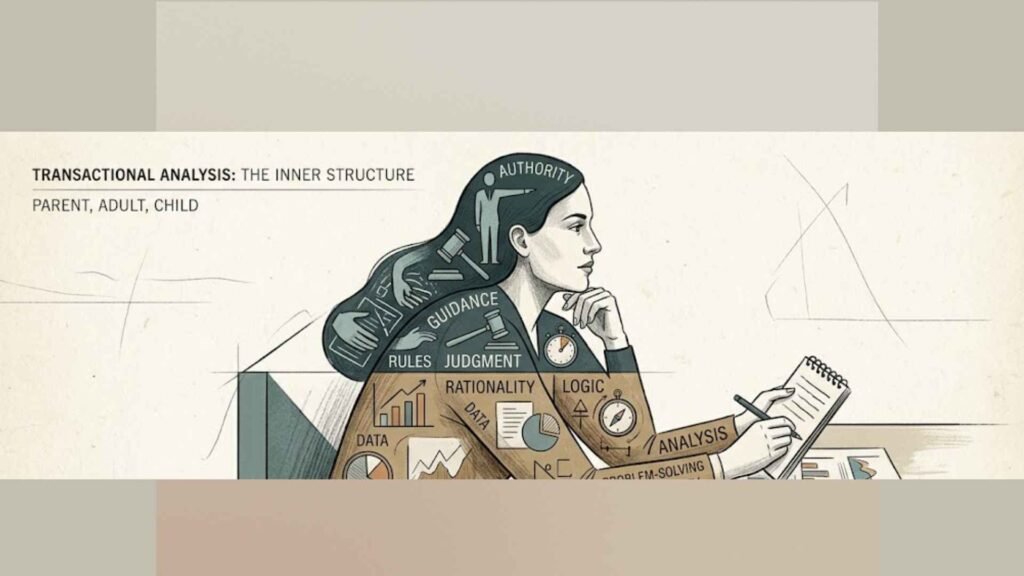
There is a curious moment in adulthood that most people recognise but rarely examine.
A manager receives criticism and, despite years of professional experience, reacts like a child being scolded at school. A parent hears their teenager challenge a decision and immediately responds in the same language their own parents once used with them. A highly educated professional knows perfectly well that an argument is going nowhere, yet continues having it.
Why?
Eric Berne, the Canadian-American psychiatrist whose work gave birth to Transactional Analysis, spent much of his career examining precisely this question.
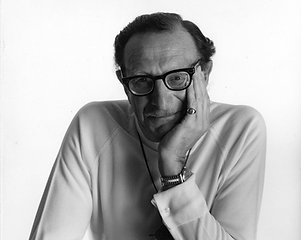
His proposition was deceptively simple: adults do not always interact from the same psychological position. Depending on the situation, a person may respond from what Berne called the Parent, Adult or Child ego state.
The terminology sounds almost too simple for psychology.
That was, in part, the point.
Berne wanted to move away from psychological explanations that were difficult for ordinary people to observe in everyday life. Instead, he developed a language for recognising patterns in conversations, relationships and behaviour.
His 1964 bestseller Games People Play took these ideas far beyond the consulting room and introduced millions of readers to the possibility that many apparently spontaneous interactions follow recognisable patterns.
More than half a century later, the Parent-Adult-Child framework remains useful as a lens for thinking about one particularly important question for educators and parents:
How much of the way we behave today was learned when we were children?
Eric Berne’s central idea
Transactional Analysis, commonly abbreviated as TA, is a psychological framework developed by Eric Berne around the study of interpersonal transactions.
A transaction, in Berne’s terminology, is an exchange between people.
When two people communicate, however, they are not necessarily communicating from the same psychological state.
A teacher may speak to a student as an authority figure. A student may respond defensively. Two colleagues may discuss the same issue rationally one day and turn it into a personal argument the next.
The words may appear similar.
The psychological interaction may not be.
Berne proposed three ego states to describe these patterns:
Parent. Adult. Child.
These should not be confused with chronological age.
The Parent is not simply an older person.
The Child is not simply a young person.
And the Adult is not synonymous with maturity.
They describe different ways in which a person can think, feel and behave.
That distinction is fundamental to understanding Berne.
The Parent ego state: the rules we inherit
The Parent ego state represents patterns of thought, feeling and behaviour that a person has absorbed from authority figures and their social environment.
A child does not enter the world knowing how to behave at the dinner table, how to speak to elders, what constitutes acceptable behaviour or what success is supposed to look like.
These rules are taught.
Sometimes explicitly.
Sometimes through observation.
Sometimes through repeated emotional experiences.
“Always tell the truth.”
“Don’t question your elders.”
“Work hard.”
“People will judge you.”
“Good children don’t argue.”
“Marks determine your future.”
“Family comes first.”
Over time, such messages can become internal reference points.
As adults, people may reproduce them without consciously deciding to do so.
This is where Berne’s Parent state becomes particularly interesting.
A parent who tells a child, “You should apologise when you are wrong,” may be communicating a constructive social rule.
Another parent who says, “You should never question an elder,” is transmitting a very different rule.
Both can originate from the same psychological category: Parent.
Berne therefore divided Parent behaviour into forms that can broadly be understood as nurturing and critical.
The important issue is not that the Parent exists.
It is that inherited rules can sometimes be applied automatically to circumstances that are fundamentally different from those in which the rules were learned.
The Adult ego state: responding to the present
The Adult is perhaps the most misunderstood element of Berne’s model.
Adult does not mean “mature person.”
It refers to a mode of processing information based on the situation at hand.
The Adult asks:
What is actually happening?
What information do I have?
What information is missing?
What are the possible consequences?
What should I do given the evidence available now?
Consider a student who performs badly in an examination.
A Parent response might be:
“You should have worked harder.”
A Child response might be:
“The teacher deliberately made the paper difficult.”
An Adult response might be:
“I lost most of my marks in two topics. I have three weeks before the next examination. I need to understand where I went wrong and change my preparation.”
The distinction is not about intelligence.
It is about the basis of the response.
The Adult attempts to process the present rather than simply reproduce an old rule or react from an emotional pattern.
For educators, this part of Berne’s framework is particularly relevant.
Education is often described as the acquisition of knowledge.
But education also has another purpose: developing the capacity to evaluate information, question assumptions and make decisions independently.
In that sense, the ability to move from automatic reaction to considered response is one of the most important forms of learning.
The Child ego state: the emotional history we carry
The Child represents patterns associated with childhood experience.
This includes feelings, impulses, creativity, spontaneity, fear, dependency and rebellion.
The word “Child” can be misleading because it is easy to interpret it as synonymous with immaturity.
Berne’s framework does not require that interpretation.
The Child can be playful.
It can be imaginative.
It can be curious.
It can also become anxious, defensive or rebellious.
A person who laughs spontaneously with friends may be expressing something quite different from the person who becomes frightened when criticised by a superior.
Both responses can be understood through the idea of ego states.
This is also where Berne’s model becomes particularly relevant to parenting.
A parent may believe they are responding to their child in the present.
But occasionally they may actually be responding to their own childhood.
A teenager says:
“I don’t want to become a doctor.”
The parent’s immediate reaction:
“Don’t be foolish. Medicine is a respectable profession.”
That response may be based on the parent’s current understanding of the child’s interests.
Or it may be an inherited definition of what a “successful” career looks like.
Berne’s framework encourages us to examine that distinction.
Why parents sometimes hear their own parents speaking through them
One of the more uncomfortable insights that can emerge from Berne’s model is that parenting does not begin with a blank psychological slate.
Parents bring their own childhoods into parenting.
They bring the phrases they heard.
The rules they were taught.
The fears they developed.
The expectations placed upon them.
The definition of success they inherited.
Some of these patterns are consciously retained.
Others operate almost automatically.
A parent may say:
“Because I said so.”
Not because they have considered whether the instruction is necessary.
But because that was once the accepted language of authority in their own childhood.
This does not make the parent a bad parent.
It illustrates something more fundamental about human behaviour:
We often reproduce patterns before we have consciously examined them.
This is one of the reasons Berne’s framework remains interesting in conversations about education.
Parent, Adult and Child in the classroom
Schools are environments where these psychological dynamics become visible every day.
A teacher has institutional authority.
A student is expected to follow rules.
Parents have expectations.
School leaders have systems and processes.
The potential for Parent-Child interactions is therefore built into the structure of education itself.
Consider two teachers responding to the same situation.
A student has not completed an assignment.
Teacher A says:
“You never take your work seriously. How many times do I have to tell you?”
Teacher B says:
“You haven’t submitted the assignment. What happened?”
The first interaction immediately introduces judgement.
The second begins with information gathering.
This does not mean Teacher B is necessarily “better”.
The context matters.
But the two statements invite different kinds of responses.
The first can encourage defensiveness.
The second creates space for explanation.
This is where the Adult state becomes practically useful as a communication concept.
The Adult does not eliminate authority.
It changes how authority is exercised.
When an ordinary conversation becomes a psychological transaction
Berne’s larger contribution was not merely identifying three ego states.
It was examining what happens when those states interact.
Imagine a manager saying:
“Please send me the report by 5 PM.”
The employee replies:
“Sure. I’ll send it by 4:30.”
The exchange is straightforward.
Now change the response:
“Why are you always checking my work?”
The original request has now become a confrontation.
The manager may respond:
“Because you keep making mistakes.”
The employee:
“You never appreciate what I do.”
At this point, the original report has almost disappeared from the conversation.
The interaction has moved into a different psychological pattern.
Berne called attention to such patterns through his analysis of complementary and crossed transactions.
A complementary transaction is broadly one in which the response comes from the ego state expected by the initial communication.
A crossed transaction occurs when the response comes from another ego state and the interaction becomes disrupted.
This gives us a useful way to analyse conflict.
Instead of asking only:
“Who is right?”
we can ask:
“What kind of transaction is taking place?”
That is a much more productive question.
The relevance of Berne to modern parenting
Parents today are dealing with an environment that is substantially different from the one in which Berne developed his theory.
Children have unprecedented access to information.
Authority is no longer exclusively located with parents, teachers and institutions.
A teenager can challenge a parent’s assumption within seconds using information found online.
Yet the psychological problem remains familiar.
Parents still have to balance authority with autonomy.
They still have to establish boundaries.
They still have to decide when to instruct and when to listen.
Berne’s framework offers a vocabulary for examining those moments.
When a child makes a mistake, is the parent’s first instinct to punish?
When a child disagrees, does disagreement feel like disrespect?
When a child succeeds, does the parent celebrate the child’s achievement or treat it as confirmation of the parent’s own expectations?
These are not questions with automatic answers.
But they are valuable questions.
The educational importance of moving from reaction to reflection
Perhaps the most useful modern interpretation of Berne’s work lies in the space between reaction and reflection.
Children learn through repeated interaction.
They observe how adults handle disagreement.
They observe how mistakes are treated.
They observe whether questions are welcomed or punished.
They observe whether authority requires obedience or can coexist with explanation.
Over time, these experiences contribute to the behavioural patterns they carry into adolescence and adulthood.
This is why the language adults use with children matters.
A child who repeatedly hears:
“You are careless.”
may eventually internalise a different message from a child who repeatedly hears:
“This mistake happened. Let’s understand why.”
The distinction is subtle.
But repeated interactions are rarely insignificant.
Does Berne’s model explain everything about human behaviour?
No.
This qualification is essential.
Transactional Analysis is a particular psychological framework. It should not be treated as a complete explanation of personality, development or human behaviour.
Contemporary psychology has developed substantially since Berne’s work, and psychological research uses many different models to understand development, cognition, emotion, attachment, learning and behaviour.
The Parent-Adult-Child model is therefore most useful when treated as a conceptual lens for examining interpersonal behaviour, rather than as a universal diagnostic system.
Its strength is its accessibility.
It gives people a language for noticing patterns.
Its limitation is the same as that of many simplified models: human beings are considerably more complicated than three categories can capture.
That distinction is particularly important when the model is applied to children.
A child’s behaviour cannot responsibly be reduced to “Child ego state”.
Development is influenced by temperament, family environment, social context, learning, relationships and many other factors.
Berne’s model can prompt useful questions.
It should not replace evidence-based psychological assessment.
What Games People Play added to the conversation
Berne’s 1964 book Games People Play expanded his ideas about interpersonal transactions into a broader examination of recurring relationship patterns.
The “games” were not literal games.
They referred to recurring sequences of transactions that could produce familiar outcomes.
This idea remains relevant because many conflicts have a repetitive quality.
The same couple may have the same argument.
The same parent and child may fight over the same issue.
The same manager and employee may repeatedly misunderstand one another.
When a conflict repeats, analysing the individual incident may not be enough.
The more revealing question may be:
What pattern are the two people repeatedly creating together?
That is the intellectual value of Berne’s work.
He shifted attention from isolated statements towards patterns of interaction.
A simple way to use the model
The Parent-Adult-Child framework can be turned into a simple reflective exercise.
When a conversation becomes emotionally charged, ask three questions.
Parent: What rule, expectation or authority message am I bringing into this conversation?
Child: What am I feeling, fearing or wanting right now?
Adult: What do the facts of the present situation actually tell me?
The objective is not to suppress the Parent or Child.
Both represent important dimensions of human experience.
The objective is to recognise them.
Recognition creates the possibility of choice.
And choice is perhaps the most valuable part of the entire exercise.
The child does not disappear when we grow up
This may be the most enduring idea to take from Berne.
Growing older does not mean leaving childhood completely behind.
Adults carry memories, learned rules, emotional responses and behavioural patterns into new relationships.
Some are useful.
Some are outdated.
Some are barely noticed until a particular situation activates them.
A difficult conversation with a parent.
A disagreement with a partner.
A confrontation at work.
A child refusing to follow instructions.
A disappointing examination result.
A career decision.
In such moments, the past can quietly enter the present.
Berne’s work provides a vocabulary for noticing when that happens.
And for parents and educators, that may be the most important lesson of all.
Children are not only being taught mathematics, language, science or social skills.
They are also learning how authority sounds.
How disagreement works.
How mistakes are handled.
How emotions are expressed.
And how people treat one another when things do not go according to plan.
The education of a child therefore extends beyond the curriculum.
It happens in thousands of small transactions that adults may barely remember but children experience repeatedly.
Perhaps the question worth asking is not simply:
“What are we teaching our children?”
It is:
“What patterns are we teaching them to carry into adulthood?”
FAQ
What is Eric Berne’s Parent Adult Child theory?
Eric Berne’s Parent Adult Child theory describes three ego states used in Transactional Analysis: Parent, Adult and Child. The model is intended to describe different patterns of feeling, experience and behaviour that can appear during interpersonal interactions.
What are the three ego states according to Eric Berne?
The three ego states are Parent, Adult and Child. Parent represents patterns associated with parental or authority figures, Adult is concerned with processing information and evaluating the present, and Child represents childhood-related feelings and experiences.
What is Transactional Analysis?
Transactional Analysis is a psychotherapeutic and interpersonal framework developed by psychiatrist Eric Berne. It analyses human interactions through concepts including ego states, transactions, games and scripts. Berne’s approach became part of the psychotherapeutic literature in the 1950s and reached a much wider audience through Games People Play, published in 1964.
Is Parent Adult Child the same as Id, Ego and Superego?
No. Berne explicitly distinguished his Parent, Adult and Child ego states from Freud’s Id, Ego and Superego. Although the two frameworks both use three-part models, they are conceptually different.
What does the Adult ego state mean?
The Adult ego state refers to a mode of processing information and evaluating the current situation. In Berne’s framework, the Adult can examine information coming from the Parent and Child states as well as information gathered from the environment.
Why is Eric Berne’s theory relevant to parenting?
The model provides a vocabulary for examining how adults communicate with children and how learned parental messages may influence later interactions. It can be used as a reflective framework, although it should not be treated as a complete explanation of child development.
What is Games People Play?
Games People Play is Eric Berne’s 1964 book that brought Transactional Analysis to a mass audience. It examined recurring patterns of interpersonal transactions and introduced concepts that became widely associated with Berne’s work.

