
In 2005, a young chartered accountant stood on the manicured lawns of the Harvard Business School with two drastically diverging paths before him.
On one hand was an offer letter from McKinsey & Company in New York City: an enviable $$175,000$ starting salary, the gold standard of corporate security, and a predictable route to pay off a suffocating $$200,000$ (roughly ₹1 crore at the time) educational debt.
On the other hand was an uncertain ticket back to India—a country whose startup ecosystem was still nascent—to build a company without venture backing, without an office, and without a salary for the next twelve months.
Ashwin Damera chose the ticket home.
He didn’t make that leap because he was reckless. He made it because two of his Harvard classmates wrote him personal checks worth $$200,000$, looking him in the eye and saying: “We know you’re a good guy. Go start.”
Fast forward to 2026. Damera is the co-founder and CEO of the Eruditus Group, one of the world’s rare profitable edtech unicorns valued at $$3.2text{ billion}$, clocking ₹4,500 crore in revenue and ₹400 crore in EBITDA. Yet, across social media and founder podcasts, a very different narrative dominates the airwaves.
When Zerodha co-founder Nikhil Kamath casually claimed that “if you’re 25 and going to an MBA college today, you must be some kind of idiot,” he ignited a generational debate.
Sitting down with Kushal Lodha on a recent podcast, Damera addressed the controversy with a smile:
Table of Contents
“Neither is Nikhil Kamath 25, nor does he have an MBA.”
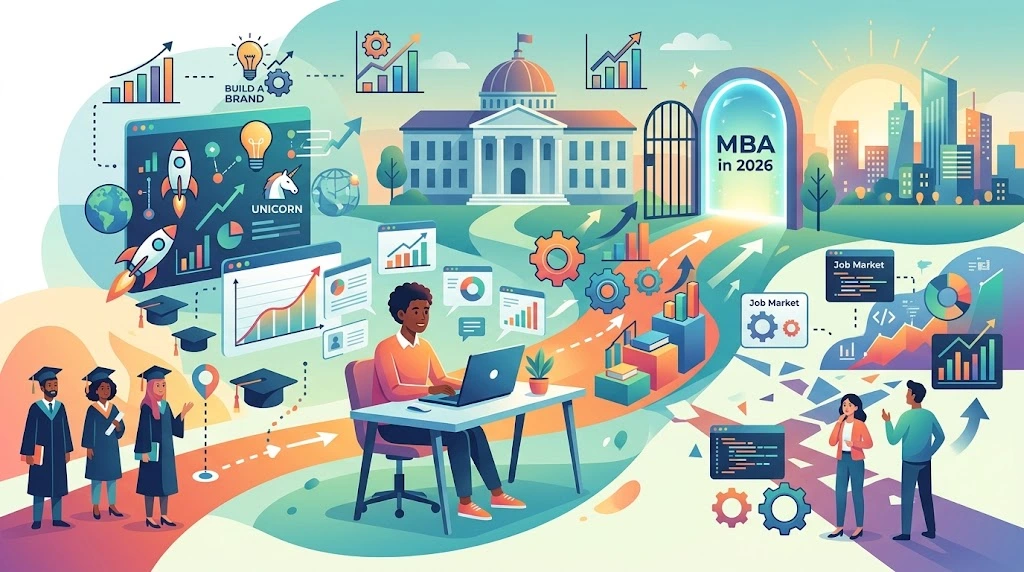
Beyond the quick wit, however, Damera unpacked a deeply nuanced, data-backed, and pragmatic defense of management education. Is the MBA dead in 2026? Or has the conversation around it simply lost touch with reality?
1. Debunking the “College Dropout” Glamour: What the Data Actually Says
Silicon Valley loves a romantic myth: the rebellious 19-year-old dropping out of college to change the world from a dusty garage.
“When I was at Harvard Business School, Mark Zuckerberg was across the river dropping out of Harvard College,” Damera notes. “It has become very fashionable to take one or two extreme anomalies—Bill Gates, Mark Zuckerberg—and paint a fantasy that dropping out guarantees startup glory.”
The data, however, tells an entirely opposite story:
- Startup Survival: Harvard Business School MBAs are statistically six times more likely to build successful startups than the general population.
- The Indian Unicorn Reality: India currently hosts approximately 108 unicorns out of more than 600,000 registered startups. Out of those 108, 80 to 90 founders are alumni of IITs, IIMs, ISB, Harvard, and Stanford.
From 600,000+ Startups
to Just 108 Unicorns
If formal business training and elite institutional backing were obsolete, the unicorn leaderboard would be dominated entirely by self-taught founders. Instead, the correlation between premier institutions and scaled enterprise remains overwhelmingly strong.
2. The Equation of Modern Success: Career Capital
Why does an elite business degree tilt the odds so heavily in an entrepreneur’s or executive’s favor?
Damera distills professional trajectory into a simple formula:
$$text{Career Capital} = text{Intellectual Capital} + text{Brand Capital} + text{Social Capital}$$
Most critics evaluate an MBA solely on Intellectual Capital—arguing that frameworks, balance sheets, and marketing principles can now be learned online or on YouTube for free. But Damera emphasizes that knowledge alone is only a third of the equation:
1. Brand Capital
When Damera was bootstrapping his first venture, Travelguru, venture capital in India was in its infancy. “When you reach out to venture funds, the partners are often from Harvard or Stanford. Saying ‘I am an MBA from Harvard Business School’ opened the door. They wouldn’t chase you away; they took the meeting.” Brand capital lends credibility when you have no operational track record.
2. Social Capital
“Early in your career, what you know gets you your first job. But as you grow, who you know matters just as much, if not more,” Damera observes.
At HBS, Damera sat beside peers like Rishad Premji (now Executive Chairman of Wipro) and Alexander Samwer (co-founder of Rocket Internet, who had already sold a company to eBay for $$75text{ million}$). When you learn alongside peers who have already executed at global scale, your psychological ceiling shatters.
3. The Compounding Math: Why Starting Salaries Matter More Than You Think
A common argument against business school is the steep tuition fee. But Damera approaches higher education through an unyielding lens: Return on Investment (ROI) and Compound Growth.
Consider two graduates entering the workforce:
- Graduate A lands a role at ₹15 LPA.
- Graduate B (backed by an industry-aligned brand) begins at ₹20 LPA.
Assuming an average annual salary increment of $12%$ for both over a 20-year career:
$$text{Differential Over 20 Years} approx text{₹}3.6text{ Crores}$$
A seemingly minor initial gap of ₹5 lakh compounds into a life-altering ₹3.6 crore variance over two decades.
Furthermore, if a professional systematically invests in executive management programs or upskilling at Years 5, 10, and 15—yielding periodic one-time jumps of $30%$ instead of standard raises—the cumulative compensation difference expands to ₹9 to ₹10 crores.
Small Differences in Starting Salary
Can Compound Into Crores
20-Year Horizon · 12% CAGR
“People frequently look at upfront tuition costs in isolation,” Damera explains. “They forget that costs are amortized, but early career momentum compounds.”
4. Where Kamath Is Right: The “Useless” MBA
Does this mean every MBA is worth pursuing? Absolutely not.
Damera is quick to delineate where management education fails:
- The Fresher Trap: In India, thousands jump directly from an undergraduate degree into an MBA classroom without ever having worked a corporate job. “If you have never sat in a performance review, never faced a difficult client, and never negotiated an agreement, how will you understand organizational strategy or negotiation case studies? You need 2 to 3 years of work experience to extract real ROI.”
- The Tier-2/Tier-3 Bookish Trap: Programs that rely on outdated, lecture-only curricula and lack corporate integration or recruiting pipelines are indeed a waste of capital.
- The Unfocused Entrepreneur: If an individual already has a validated product, burning customer demand, and an urgent problem to solve, pausing to pursue an MBA makes little sense. An MBA is suited for those looking to pivot, build cross-functional skills, build an elite network, or find their calling.
5. The 2026 Paradigm Shift: Global Degrees on Indian Soil
For decades, Indian families operated under a binary dilemma: “Settle for local colleges, or spend ₹2.5 crore to go abroad.”
In 2026, the traditional study-abroad pathway faces unprecedented headwinds:
- F1/STEM Visa Bottlenecks: Student visa rejections in key Western markets hover around $50%$ to $55%$, driven by domestic political pressures and housing crunches in Canada, Australia, and the UK.
- Skewed Foreign ROI: A four-year undergraduate degree in the US can cost ₹2 to ₹2.5 crore. If a student fails to secure a local H-1B or OPT job and returns to India to start at ₹15–20 LPA, the payback period stretches beyond 20 years.
To solve this dilemma, foreign universities are setting up direct, offline campuses within India—pioneered through strategic operational partnerships with Eruditus.
Instead of paying ₹1.5 to ₹2.5 crore, students can now enroll in campuses established in Mumbai, Bengaluru, and NCR by top-ranked global institutions:
| University | Global Rank / Origin | Indian Campus Location | Estimated Cost (Full Program) | Notable Feature |
|---|---|---|---|---|
| UNSW (New South Wales) | Top 20 Global (QS) | Bengaluru | ~ ₹30 – 32 Lakhs | Highest-ranked foreign university in India |
| University of Bristol | Top 50 Global (QS) | Mumbai | ~ ₹30 – 40 Lakhs | Access to ₹12,000 Cr ($£1text{B}$) AI Supercomputer |
| Illinois Tech | Top US Tech / STEM | Mumbai | ~ ₹40 Lakhs (net) | 1-year Chicago transfer option included |
| University of Liverpool | UK Russell Group | Bengaluru | ~ ₹30 Lakhs | On-site Biomedical Lab; 10 min from Unilever R&D |
| University of York | UK Top 150 | Mumbai | ~ ₹30 Lakhs | Business of Creative Industries & Media Lab |
| University of Aberdeen | Est. 1495 (Scotland) | Mumbai | ~ ₹35 – 40 Lakhs | Flexible 4-year Scottish honours model |
| Victoria University | Australia | NCR (Gurugram) | ~ ₹24 Lakhs (net) | Revolutionary 6-week “Block Teaching” model |
“For the cost of spending one year in Chicago or London, you can now complete your entire degree in India—with the exact same degree awarded by the home university, 50% foreign faculty, and options for semester exchanges abroad,” says Damera.
6. The 2026 Playbook: Three Unnegotiable Skills
When asked what skills young professionals must cultivate in 2026 to stay irreplaceable, Damera bypassed the usual buzzwords to highlight three pillars:
1. Practical AI Literacy
“Everyone talks about AI, but you must be literate enough to use it to collapse time. What used to take our teams three months to build in educational simulations can now be drafted in two weeks with agentic workflows.”
2. High-Stakes Soft Skills & Negotiation
Damera recalls studying under Professor Jim Sebenius at Harvard, learning that negotiation is not about pounding tables or turning down the air conditioning to make an opponent sweat. It is about pre-meeting architecture: deciding the venue, orchestrating board presence, and mastering influence without formal authority.
3. Active Social Architecture (The Science of “Weak Ties”)
Networking often carries an unfortunate, transactional reputation in corporate India. But Damera views it through organizational sociology:
- Strong Ties: Your close friends and immediate team. They offer emotional safety, but rarely provide novel information because they swim in the same circles.
- Weak Ties: Industry acquaintances, overseas professors, and cross-sector founders whom you contact once or twice a year. Novel opportunities, funding leads, and unexpected breakthroughs almost always travel through weak ties.
The Verdict: Beyond the Vanity Metrics
When asked how he wants to be remembered at the end of his career, Damera sidestepped the vanity of valuation tables.
“Unicorn founder, billionaire—it’s all nice to hear. But one day, everybody is going to die. My real legacy is: on that day, how many people stand up and say, ‘This person changed my life’? If that number is large, that is a life well-valued.”
That perspective cuts straight to the heart of the modern MBA debate.
The degree is not a lottery ticket, nor is it a guaranteed passport to instant riches. If your goal is to spend ₹30 lakh sitting passively in an unaccredited lecture hall, memorizing slide decks from 1998, Kamath is right: you are wasting your youth and your capital.
But if you approach management education with real battle scars from two to three years of work experience, the calculus changes entirely. An elite MBA does not merely teach you what to think; it introduces you to the people who will write your first startup checks, arms you with the soft skills to lead teams without raw authority, and roots you in an undeniable institutional pedigree.
The MBA isn’t dead in 2026. It has simply stopped tolerating mediocrity—and started demanding that you build real career capital.
Editorial Attribution & References
This story was curated and adapted from an in-depth conversation between Ashwin Damera and Kushal Lodha.
- 🎥 Watch the full podcast episode: YouTube: Ashwin Damera on Education, MBAs, and Building Eruditus
- 💼 Follow the guest: Connect with Ashwin Damera on LinkedIn

