As Artificial Intelligence rapidly evolves, educational stakeholders across India face a pivotal question: Will AI disrupt academic integrity or democratize high-quality learning? Drawing from Sal Khan’s seminal TED Talk, “How AI Could Save (Not Destroy) Education,” this article examines how generative AI can solve age-old pedagogical challenges—from personalized 1-on-1 tutoring to reducing teacher burnout—while establishing essential ethical guardrails for implementation in developing nations.
Table of Contents
Introduction: Moving Beyond the Fear of AI in Classrooms
The global debate surrounding Artificial Intelligence in education often tilts toward anxiety: concerns over automated cheating, algorithmic bias, and the erosion of human connection. However, as Sal Khan, founder and CEO of Khan Academy, demonstrates in his presentation, avoiding technology is neither practical nor beneficial. Instead, society must actively shape AI to enhance human potential, intelligence, and purpose.
For India—a nation striving to fulfill the ambitious goals of the National Education Policy (NEP) 2020 across vast, socio-economically diverse demographics—generative AI represents a watershed opportunity to bridge systemic learning gaps.
“Rather than fearing the disruption of education, society should actively participate in shaping AI to enhance human intelligence, potential, and purpose.”
— Sal Khan, Founder & CEO, Khan Academy
The 2-Sigma Solution: Personalized AI Tutoring at Scale
One of the most persistent hurdles in mass education is Benjamin Bloom’s 2-Sigma Problem, which established that an average student tutored 1-on-1 performs two standard deviations above students in a conventional classroom setting. Historically, delivering individual tutoring to millions of students was economically impossible.
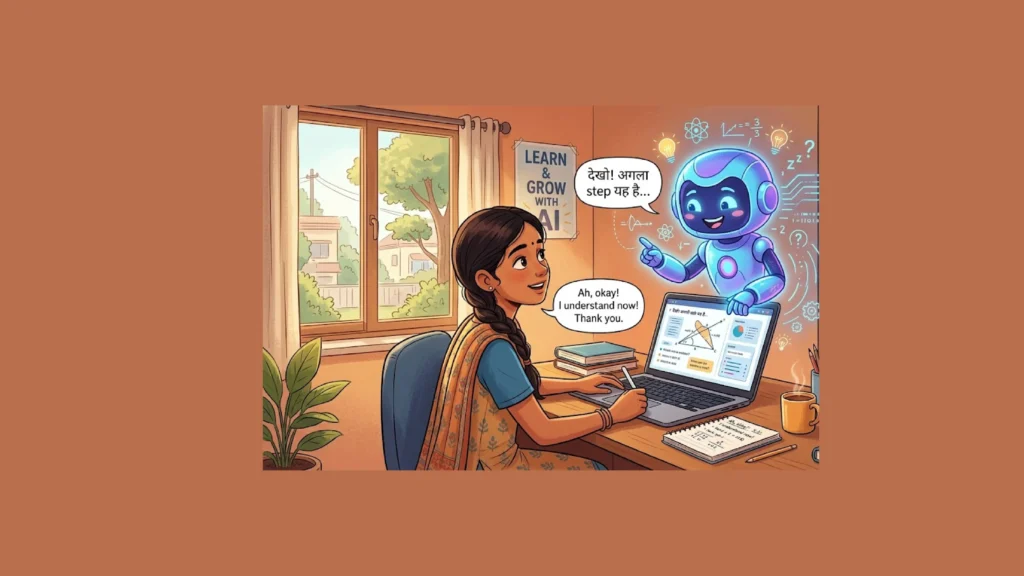
Khan introduces Khanmigo, an AI-powered educational tutor designed to solve this scaling problem. Crucially, Khanmigo does not simply give students answers; it acts as a Socratic guide.
Key Capabilities of AI Tutors:
- Guided Problem Solving: Asks probing questions when a student makes an error in mathematics or logic rather than revealing the solution.
- Adaptive Pace: Adjusts to individual learning speeds, ensuring foundational concepts are mastered before advancing.
- Socratic Pedagogy: Encourages active recall and critical thinking during exercises.
In the Indian context, where pupil-teacher ratios in many state schools remain high, Socratic AI tools can democratize personalized attention for rural and underprivileged learners without requiring an unachievable expansion in human tutoring staff.
Empowering the Educator: AI as a Teaching Assistant
A common misconception is that AI intends to replace human teachers. On the contrary, Khan emphasizes that AI’s greatest power lies in serving as an indispensable teaching assistant.
Teachers spend dozens of administrative hours weekly on lesson planning, assignment grading, and generating progress reports. Generative AI platforms can automate these tasks in seconds, freeing educators to focus on what matters most: direct, emotional, and social engagement with students.
+-------------------------------------------------------------------+
|                  REDEFINING THE TEACHER'S ROLE                    |
+-------------------------------------------------------------------+
|  TRADITIONAL MODEL              |  AI-AUGMENTED MODEL             |
|  • Hours spent grading papers   |  • Automated initial grading    |
|  • Generic lesson planning      |  • Customized lesson designs    |
|  • Limited individual feedback  |  • Real-time data & analytics   |
|  • High burnout risk            |  • High human-to-human focus    |
+-------------------------------------------------------------------+
By leveraging AI assistants, Indian educators can effortlessly curate bilingual content, adapt curricula to local contexts, and track learning outcomes at granular levels.
Interactive Learning: Debates, Creative Writing, and Historical Roleplay
Generative AI unlocks novel pedagogical methods that transcend traditional rote learning—a long-standing challenge in Indian schooling.
Innovative AI Classrooms Features:
- Historical and Literary Simulations: Students can engage in structured debates with AI avatars representing historical figures (e.g., Mahatma Gandhi, APJ Abdul Kalam) or literary characters, testing their understanding of complex contexts.
- Collaborative Writing: Rather than writing essays for students, AI acts as a co-writer, asking for outlines, giving critique on thesis statements, and prompting richer vocabulary choices.
- Gamified Critical Thinking: AI introduces counterarguments in real-time, forcing students to defend their logic and evaluate source credibility.
Safety First: Guardrails, Privacy, and Accuracy
Deploying AI in K-12 and higher education demands rigorous safety protocols. Unfiltered access to large language models can expose students to hallucinations or unsafe content.
Khan outlines critical implementation principles for EdTech developers and policymakers:
- Teacher Transparency: All student-AI interactions must be visible to educators, providing complete transparency and actionable data on student engagement.
- Deliberate Inference (“Thinking” Steps): Systems should be engineered to perform backend logic and multi-step reasoning before outputting answers, drastically reducing mathematical and factual hallucinations.
- Data Privacy and Ethics: Student data must be safeguarded under stringent local data protection mandates (such as India’s Digital Personal Data Protection Act).
Key Policy Takeaways for Indian Education
For Indian policymakers, EdTech innovators, and academic administrators, Khan’s insights point toward clear strategic imperatives:
- Focus on Access over Abstraction: AI initiatives should prioritize multi-lingual capabilities (Hindi, Tamil, Bengali, Marathi, etc.) and low-bandwidth accessibility to serve tier-2, tier-3, and rural regions.
- Teacher Professional Development: Invest in training educators to use AI as a productivity tool rather than viewing it as a threat.
- Promote Pedagogy Over Automation: Select EdTech tools that prioritize Socratic questioning and deep comprehension over quick answer-generation.
Frequently Asked Questions (Q&A)
Q1: Will AI replace teachers in Indian schools?
Answer: No. AI is designed to augment teachers, not replace them. By automating administrative tasks such as lesson planning and basic grading, AI gives teachers more time to build meaningful relationships, mentor students, and facilitate social-emotional learning.
Q2: How does an AI tutor prevent students from cheating?
Answer: Purpose-built educational AI engines (like Khanmigo) are programmed with strict safety and pedagogical guardrails. Instead of providing direct answers, the AI asks guided, Socratic questions that force students to demonstrate comprehension and work through problems step-by-step.
Q3: How can AI help bridge the educational divide in rural India?
Answer: AI can offer localized, personalized instruction at scale. By adapting content into regional languages and adjusting to an individual student’s learning speed, AI allows students in under-resourced schools to access world-class, 1-on-1 instruction.
Q4: What is Benjamin Bloom’s “Two Sigma” goal in education?
Answer: Educational psychologist Benjamin Bloom found that students who received 1-on-1 tutoring performed two standard deviations (or two “Sigmas”) better than students taught in standard classrooms. Generative AI makes scalable 1-on-1 tutoring economically feasible for all students for the first time in history.
Source
- Speaker: Sal Khan (Founder & CEO, Khan Academy)
- Source Title: “How AI Could Save (Not Destroy) Education”
- Publisher: TED Conferences
- Key Segments Cited:
- Personalized AI Tutoring & Bloom’s 2-Sigma Goal (1:08 – 2:25)
- Guardrails and System Logic (2:36 – 3:00, 12:22 – 13:05)
- Interactive Debates & Collaborative Writing (5:35 – 8:40)
- Educator AI Assistants (10:25 – 11:26)
- Human Potential & Purpose (14:10 – 15:28)